
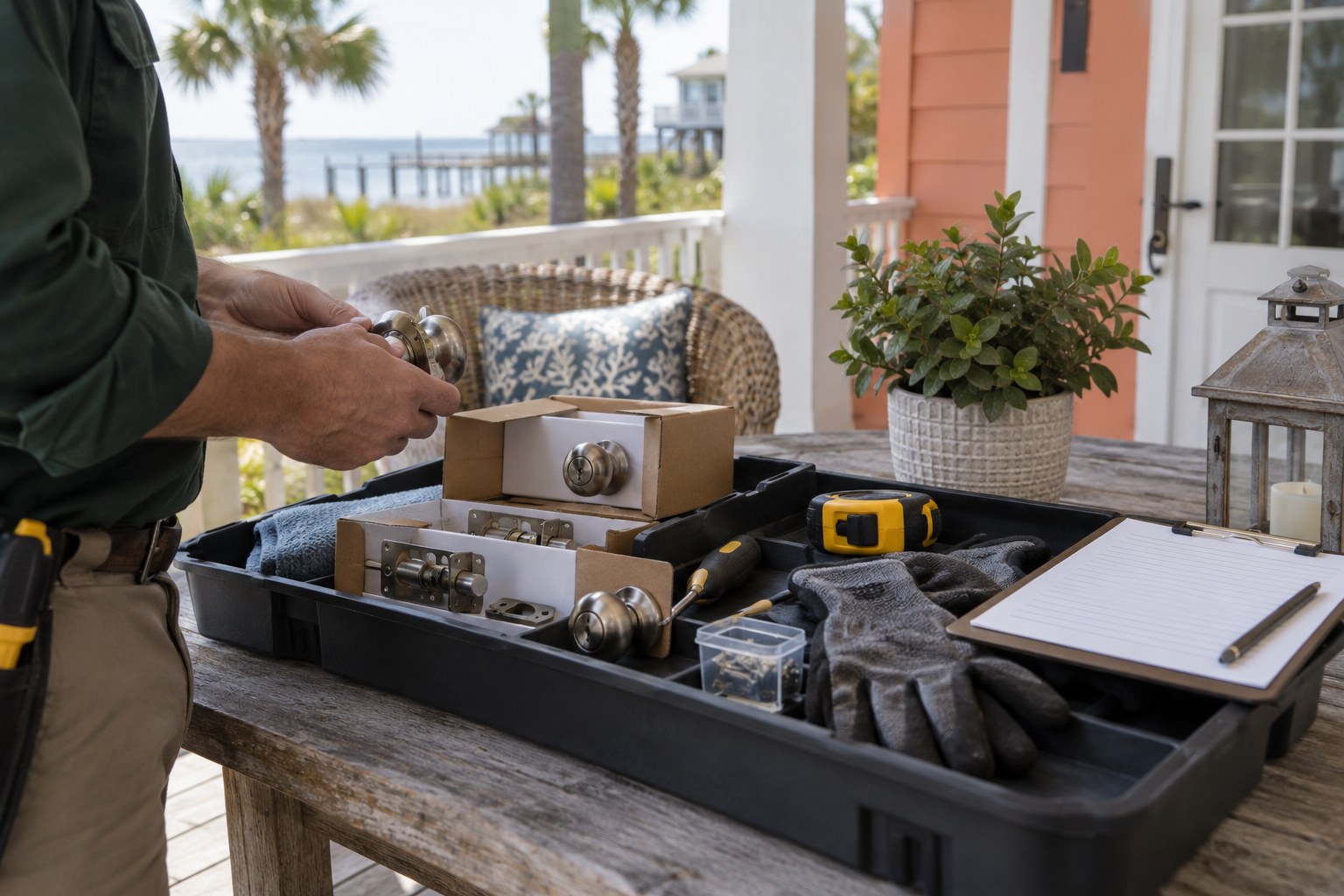
How the inside of a deadbolt works
On the inside of most deadbolts is a small knob or lever called a thumb turn. It sits on a shaft that passes through the door and connects to the bolt mechanism. When you turn it, a small metal piece called a tailpiece or a spindle rotates, which drives a cam, which pushes the bolt out of the door edge.
Between the thumb turn and the bolt are several connection points, each held by a screw, a clip or a tight fit. If any of these gives way, the thumb turn can spin without moving the bolt, or stop moving altogether. The lock might look perfect from inside while the linkage behind it has failed.
The inside and outside parts of the lock are held together by two long screws, usually hidden under the interior plate. Time, vibration and door slamming can loosen them, so the whole assembly shifts, and the thumb turn no longer lines up with the bolt.
Knowing these parts helps you decide what to check first and what to leave to a technician.
The thumb turn spins but the bolt does not move
This is the most common version. You turn the knob and it rotates freely, with no resistance, as if it were not attached to anything. The cause is usually a broken or disconnected tailpiece, a stripped set screw or a cracked plastic part inside the thumb turn assembly.
Many deadbolts use inexpensive plastic or soft metal pieces in the thumb turn. Over thousands of turns, they wear, crack and finally let go. In humid coastal homes, corrosion can weaken the metal further. The break often happens just after a hard turn when the bolt was sticking.
Look at the thumb turn. If it wobbles or you can pull it slightly away from the door, it may have come loose. Try the key from outside. If the key moves the bolt, the bolt itself is fine, and the problem is on the inside.
Do not keep twisting. A broken piece can fall into a position that jams the lock, and then even the key may stop working.
The thumb turn is stiff or hard to move
A thumb turn that needs force to move usually points to friction somewhere along the path. The bolt may be rubbing on the strike plate. The door may have shifted. The mechanism may be dirty, dry or corroded.
Test with the door open. If the thumb turn moves smoothly and the bolt travels freely in open air, the lock is fine and the door is binding. If it is stiff even with the door open, the mechanism needs cleaning or repair.
A little dry lubricant on the bolt edge and around the thumb turn shaft can help. Avoid heavy oil. Clean around the strike plate hole and check for paint or debris.
If a lock has become hard to turn, replace it soon. Forcing a stiff thumb turn is how many breaks happen.
- Test the thumb turn with the door open
- Look at where the bolt meets the strike plate
- Use dry lubricant only on moving metal parts
- Never force a stiff thumb turn with pliers
Alignment and the strike plate
Sometimes the lock is working, but the bolt cannot enter the strike hole. You turn the thumb turn, the bolt extends and hits the frame. This feels like the lock cannot lock. A door that has dropped slightly, swollen with moisture or been repainted often develops this problem.
To check, extend the bolt with the door open, then close the door slowly and see where the bolt meets the frame. Look for scuffs on the strike plate. If the bolt hits above or below the hole, the door or plate needs adjustment.
Tightening hinge screws, especially the top one, often lifts the door. Moving the strike plate or enlarging the hole by a small amount can also fix it. A technician has the tools to do this neatly, so the frame is not weakened.
Longer screws in the strike plate also improve security, since they reach the framing behind the jamb.
Loose mounting screws and shifting parts
Look at the two screws that hold the interior plate and thumb turn. If they are loose, the plate and the whole lock can rock. When this happens, the shaft inside no longer lines up with the cam, and the thumb turn feels loose or fails to engage.
Tighten the screws gently with a screwdriver, a little at a time, alternating between them. Do not overtighten, since that can bind the lock. Test the thumb turn after each adjustment.
If the screws spin without tightening, the holes are stripped, or the lock has been fitted with the wrong length. A technician can install proper screws or replace the lock.
A lock that comes loose again and again may have a worn door bore or a cracked latch plate.
Broken thumb turn and snapped shafts
If the thumb turn has broken off, you may see a bare stub or an empty hole. Some thumb turns snap at the base after a hard push, a child pulling on them or corrosion weakening the metal. The inside of the lock then offers nothing to grip.
In that case, the bolt can still be moved with the key from outside, or with pliers on the stub, but that is a temporary measure. A technician replaces the thumb turn assembly or the whole lock, depending on the model.
Parts for older or uncommon locks may be hard to find, and replacing the lock is often simpler. A technician can match the new lock to your door and key it to match your other locks.
If the thumb turn is broken, the door can be locked from outside with a key, but cannot be locked from inside. Plan for safety accordingly.
Staying secure until repairs are done
A door that cannot be locked from inside is a risk, especially at night. If the lock still works with the key from outside, you can lock it when you leave, but while you are home it stays open to anyone who tries the handle. Think about what temporary steps will keep you safe.
Use a door bar, a wedge under the door, a portable door lock or a chain if you have one. These are not as strong as a deadbolt, but they slow a person down and warn you. Make sure everyone in the home can still exit quickly in an emergency.
If you have a second door with a working lock, use it. Keep the broken door closed and block it with furniture if practical, but never block the only exit.
Call us to arrange a repair and confirm availability. The quicker the lock is working again, the shorter the time you spend with a weak door.
How a locksmith repairs the lock
The technician starts by examining the interior and exterior of the lock. They remove the interior plate, look at the tailpiece, cam and mounting screws, and test the bolt by hand. This shows which part has failed.
If a screw or clip is loose, they tighten or replace it. If the tailpiece is broken or the thumb turn is cracked, they fit new parts. If the cylinder or bolt mechanism is worn, they may replace the deadbolt.
They also check the door and frame. If alignment is poor, they adjust the strike or hinges. They test the finished lock many times with the door open and closed.
Quotes are given by phone for common work, and availability should be confirmed on the call. If the job is complicated, a technician visits first, and the service call charge is explained before dispatch.
Rentals, landlords and shared homes
In a rental, a lock that will not lock from inside is a landlord matter in most cases. Report it in writing, and ask when it will be repaired. Keep a copy of your request. If it is urgent for your safety, explain why.
A locksmith can repair or replace the lock once the owner approves, or once you show you have permission. We confirm authority before working on any lock.
In shared homes, tell your housemates. Everyone should know that the door is unreliable and how to secure it.
After repairs, ask for new keys to be provided to every resident who needs them.
Prevention and everyday care
Be gentle with the thumb turn. Turn it with a light, even motion, not a hard twist. Teach children to use it properly, and avoid hanging things from it.
Check the lock twice a year. Tighten screws, wipe off dust, apply a drop of dry lubricant and test the bolt with the door open. Listen for grinding or clicks.
Keep the door in good condition. Seal the edges against moisture, keep hinges tight and ensure the door closes without force.
Replace old locks before they fail. A lock that has served for fifteen or twenty years may be due for replacement.
Kids, guests and thumb turns
Thumb turns see a lot of rough handling from young children, who enjoy twisting them, and from guests unfamiliar with the lock. A thumb turn that sticks out far on a long shaft is easy to snap. Look for models with a sturdy metal thumb piece, and show everyone how to use it gently.
If you have a toddler, consider a lock that is harder to operate by accident, or place a cover over the thumb turn. A child who can lock the door from inside while a parent is outside creates a lockout, so supervision matters.
Guests staying in a rental or a spare room may not know that the thumb turn has a particular direction. A simple label or a short instruction card helps. Forcing the wrong way is a common cause of breakage.
If a lock has been broken by rough use, a technician can suggest a more durable model and fit it correctly, with good screws and an aligned strike.
Double cylinder, keyed inside locks and safety
Some deadbolts have a key cylinder on the inside as well as outside, instead of a thumb turn. These are called double cylinder locks. If the inside key is missing, you cannot lock or unlock from inside. This is not a broken lock, but it feels the same, and it can be a safety issue in a fire.
Many areas restrict double cylinder locks on residential doors, because they can trap people. Check local rules and consider replacing the inside cylinder with a thumb turn. A technician can do this on many models without replacing the whole lock.
If you have a double cylinder lock and have lost the key, a locksmith can open it and fit a thumb turn or rekey it so you have a working key. We confirm ownership first.
Keep a key for the inside lock in a known place near the door, out of reach of children and not visible from outside.
Signs it is time to phone for a door that will not latch from indoors
Call if the thumb turn spins, sticks, snaps or fails to extend the bolt. Tell us the type of lock, how old it is, whether the key works from outside and what you have tried.
Photos of the interior plate and thumb turn help. A video of the thumb turn in action is even better.
We confirm that you own or have authority over the property before work begins. This is routine for every customer.
Please keep pets secured and clear a path to the door.
Night routines and what an unlockable door means
Most people lock the front door as a last step before bed, almost without thinking. When the lock stops cooperating, that small ritual is suddenly missing, and many households feel uneasy. It is worth taking the feeling seriously, because a door that cannot be secured also affects insurance, children and anyone living alone.
Think about the layers around the door. Outdoor lighting, a clear view from the street, a camera or doorbell, and neighbors who notice unusual activity all add to the barrier. None replaces a lock, but they reduce the chance of someone testing the handle. Turn on porch lights and leave a radio or lamp on in the evening until the repair is done.
If you must sleep with a door that does not lock, place a simple alarm on it. Inexpensive door alarms and contact sensors make a loud sound when the door opens, and they work with no wiring. A wedge under the door or a bar across it adds physical resistance, and both are quick to remove in an emergency.
Do not leave the situation for weeks. A repair is usually short, and the longer you wait, the more likely the thumb turn is to fail completely or the cylinder to jam, which can turn a small repair into a lockout.
The sliding latch, chain and secondary devices that stand in for a failed deadbolt
Sometimes a deadbolt cannot be repaired the same day, and you need a way to feel safe for a night or two. A few secondary devices can fill the gap, though none are a replacement for a properly working lock. A door chain or a swing bar adds resistance and lets you open the door a little to see who is there. A removable brace or a wedge placed under the door handle can resist pushing from outside. These are temporary measures and they depend on the door and frame being sound.
Check what you have before relying on it. A thin chain screwed into a weak jamb gives way under modest force, and a stop made of soft metal bends. Long screws that reach the wall framing help, and a technician can install them as part of the visit. For sliding doors, a wooden dowel or bar cut to fit the track is a classic and surprisingly strong stopgap. Make sure everyone in the household knows how to remove any device quickly in case of an emergency exit.
It is worth remembering that a door which cannot be locked from inside is usually one repair away from being fine. Do not leave it for weeks while hoping the problem fixes itself. A loose thumb turn, a misaligned bolt or a worn cylinder tends to get worse with use. Call when you notice the symptom, describe what the lock does and does not do, and arrange a visit at a time when someone can be home. Calm, early repair is easier than a late-night scramble.
Choosing a stronger deadbolt when you replace it
When a deadbolt fails, it is a good time to look at the next one. Deadbolts come in different grades, and the better ones use thicker metal, a longer bolt and a sturdier thumb turn. A bolt that extends a full inch into the frame resists force much better than a short one, and a solid metal thumb turn survives rough handling.
Look at the strike plate and screws that come with the lock. A strong lock with short screws in a thin jamb is only as good as the jamb. Ask the technician to use three inch screws in the strike plate and the hinge side so the door and frame are tied into the wall framing.
Think about how you use the door. If you often come in with full hands, a keypad or a keyless entry deadbolt can be helpful. If you prefer a simple mechanical lock with no batteries, a high quality keyed deadbolt with a thumb turn is a reliable option that needs little care.
Whatever you choose, the locksmith can key it to match your other locks, so one key works for the front, back and garage doors. The decision is yours, and there is no pressure to upgrade beyond what you want.
Questions people ask us
Why does my deadbolt thumb turn spin freely?
The thumb turn is disconnected from the bolt, usually because a tailpiece, clip or screw has broken. A technician can replace the failed part or the lock.
Can I lock the door from outside with the key if the thumb turn is broken?
Often yes, if the outside cylinder still works. But you cannot lock it from inside, so arrange a repair soon.
Is it okay to tighten the screws myself?
Gently, yes. Loose screws are a common cause. Stop if they spin freely or if tightening makes the lock stiffer.
Do I need a new deadbolt or just a new thumb turn?
It depends on the model. Some allow thumb turn replacement. For others, a new deadbolt is simpler. The technician will explain.
How can I keep the door secure meanwhile?
Use a door bar, wedge or portable lock from inside, and keep a safe exit route. Call to arrange repair and confirm availability.