
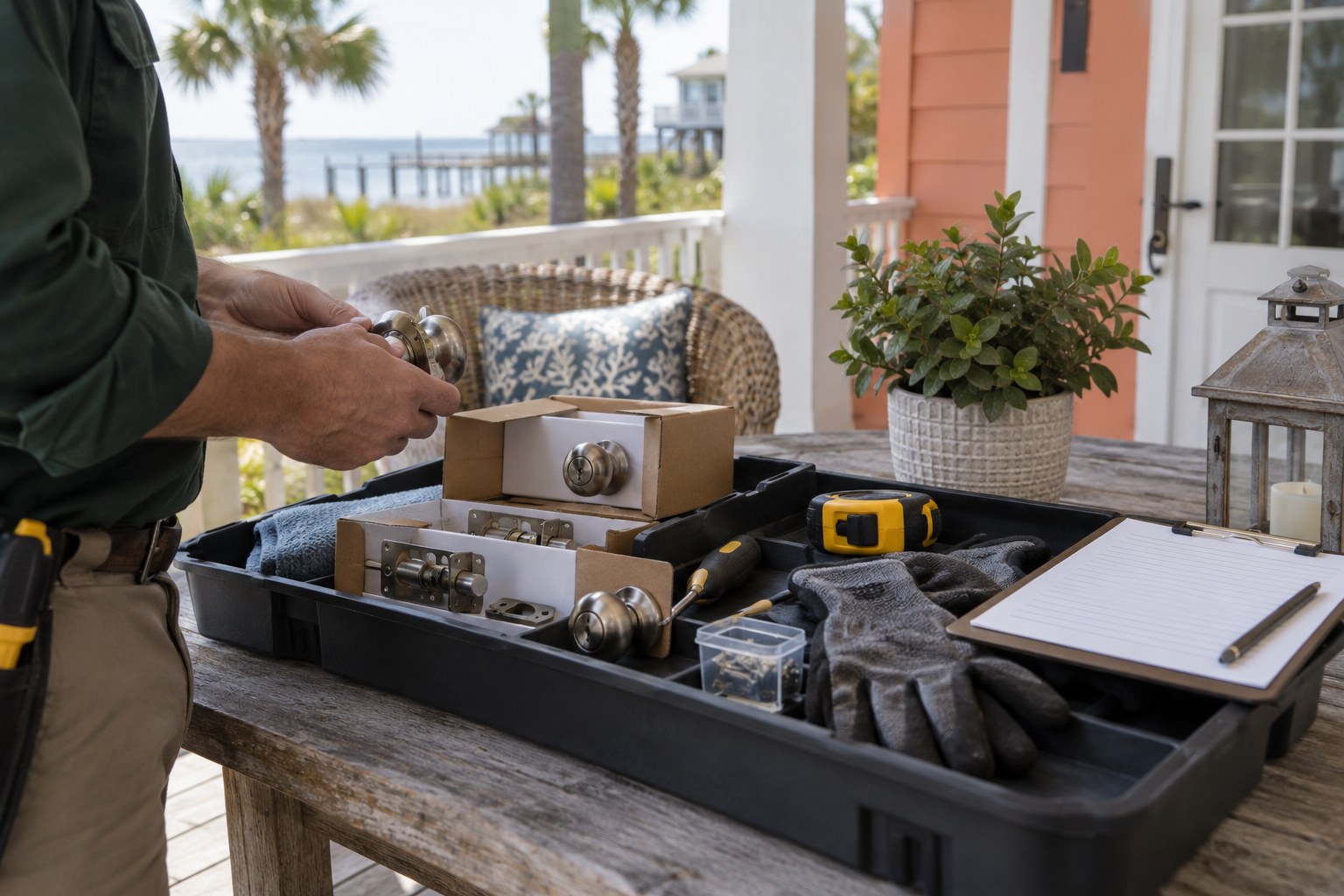
Passage, privacy and keyed interior locks
Interior door hardware comes in a few basic types. A passage set has a handle on each side that retracts the latch but has no lock. It is used on closets, hallways and rooms that never need locking. A privacy set adds a small button or turn on the inside that locks the handle, for bedrooms and bathrooms, and has a tiny emergency release on the outside.
A keyed interior lock, sometimes called an entry or office function, has a key cylinder on one side. It is used for home offices, storage rooms, wine closets, or rooms where children are not meant to go. A dummy handle is a plain handle fixed to the door with no latch, used on closets, double doors and the inactive side.
Knowing which type you have helps you describe a problem and shop for a replacement. The type is often visible by looking for a button, a slot in the handle or a cylinder. Matching the function is as important as matching the finish. A passage handle cannot be locked, and a privacy handle should never be used where the room needs to be locked from outside.
The emergency release on privacy locks
Privacy locks are designed so the door can always be opened from the outside in an emergency. On the outside handle there is usually a tiny hole or slot. Pushing a thin rod, a small screwdriver or a straightened paper clip into the hole releases the lock. In some models, a coin turns a slot instead. The design is deliberate and standard.
Every household with children should know where the release is and which tool works on their doors. Keep a suitable pin or small screwdriver on top of the door frame or in a drawer nearby, where adults can reach it but small children cannot. Test the release on each door once, so you are not experimenting in a panic.
Some older or cheaper locks lack an outside release. In that case the door may need to be opened by removing the hinge pins, forcing the latch, or removing the handle. A technician can fit a proper privacy set that includes the release, which is a modest and sensible safety upgrade, particularly in bathrooms and children's bedrooms.
When a child is locked behind a door
Stay calm, and keep your voice steady so the child does not panic. Ask them to move away from the door and to stay put. First try the emergency release with a thin tool. Often this opens the door in seconds. Talk to the child while you do it, and tell them what you are doing, so they know they are safe.
If the release fails, check the other side of the door for a latch you can reach, such as through a gap. Another option is to remove the hinge pins, if the hinges are on the room side, by tapping them out. Only try these if you are confident. If a child seems distressed, hurt or unresponsive, call emergency services immediately.
If you cannot open the door safely, call us. Describe the situation clearly: the age of the child, the room, the door type and whether the child is safe. Call us to confirm availability. A technician can open most interior locks quickly and without damage. We do not give any time promise, but we treat these calls with appropriate urgency.
Handles that spin, stick or fall apart
Interior handles take a lot of wear. Children swing on them, people lean on them, and the screws gradually loosen. A handle that spins without moving the latch typically has a broken spindle or a stripped set screw. A handle that sags may have lost its screws or a spring. Tightening is the first step, using the right screwdriver.
Latches wear too. The angled latch bolt can become sticky, the spring can weaken, or the strike plate can be misaligned. A door that must be pulled to latch, or that rattles in the frame, usually has a strike problem. Moving the strike a fraction or adjusting the hinges solves most of these without replacing the handle.
If parts are broken, a new passage or privacy set is usually inexpensive and quick to fit. Standard bore sizes mean that most modern handles fit existing holes. Measure the backset and note whether the door has a round or square latch plate. A technician can check the door and fit a set that suits it, leaving it operating smoothly.
- Tighten loose screws and set screws first
- Check the latch bolt and strike alignment
- Match backset and latch plate shape when replacing
- Choose the function: passage, privacy or keyed
Bathroom doors and humid conditions
Bathroom doors live in steam and splashes. Metal handles corrode, finishes peel, and wooden doors swell. A privacy lock that sticks may be rusted inside. In the Pensacola climate, bathrooms without strong ventilation exacerbate the problem. Using the fan and opening a window reduces moisture and prolongs the life of the hardware.
Choose a hardware finish that resists moisture, such as stainless, brass with a protective coating, or a quality plated product. Avoid cheap plated handles that blister in humid rooms. If a door swells and rubs, sanding or planing the edge may be needed, though sealing all edges, including the top and bottom, with paint helps long term.
Check the strike and latch if the bathroom door suddenly resists closing. Swollen frames shift the alignment. Do not force the door shut, as this can damage the latch and the frame. A small adjustment can restore smooth action. If the door has warped, a carpenter may be required, and a locksmith will say so.
Bedroom locks and household privacy
Bedroom privacy locks suit shared homes, teenagers' rooms and rental situations. A privacy button gives a sense of security without a key, and it can be released from the outside in an emergency. For households with roommates, a keyed bedroom lock offers more control, as the occupant can lock the room when leaving.
A keyed lock on a bedroom has safety implications. Occupants must always be able to leave quickly, so the inside handle should open freely without a key. Entry function locks, where the inside always lets you exit and the outside is keyed, are the right design. A double keyed lock would trap someone in a fire, and should not be used.
In rentals, check the lease before changing bedroom locks. Landlords often allow interior changes more readily than exterior ones, but permission is still wise. A locksmith checks authority. Keep the original hardware if requested. Agree who holds keys, and provide the landlord with access if the lease requires it.
Home offices, storage rooms and keyed interior doors
People who work from home often want to lock their office to protect papers and equipment. A keyed office function lock does this. It locks from the outside with a key and lets you leave at any time from the inside. Some models let the inside button hold the latch open. Choose one that fits your door and doesn't need unusual cutting.
Storage rooms, wine closets and tool rooms also benefit from a keyed lock. A deadbolt may suit if the room holds valuables. Keep the door solid and the frame sound, because interior doors are often hollow and weak. Reinforcing the door edge and strike adds security. A technician can advise on how much protection is practical.
Remember emergency access. If a child or elderly relative could be locked in, make sure the interior side is always operable. Keep a spare key with a trusted person. Label keys discreetly. A keyed room with no accessible key is a source of stress, so plan where keys will live.
Replacing interior hardware step by step
The technician removes the old handles by unscrewing the visible screws or releasing a hidden clip. The latch is withdrawn from the edge by removing two screws. The bare holes are inspected for damage. Chipped or oversized holes may need a filler or a cover plate to hold the new hardware firmly.
The new latch is slid into the edge bore, and its faceplate is fitted flush. The handle halves are joined through the door, with the spindle passing through the latch. Screws are tightened evenly, and the handle is tested for easy movement. A handle that binds is often too tight or misaligned, and a small adjustment fixes it.
The strike plate on the frame is checked and adjusted so that the latch engages cleanly. Finally, the door is closed and tested repeatedly. For privacy sets, the lock button and the emergency release are tried. For keyed locks, the key is tested from the outside. A good installation closes with a gentle click and no rattle.
Pocket doors, bifold doors and unusual interiors
Not all interior doors swing on hinges. Pocket doors slide into the wall and use recessed hardware with a small pull and a hook latch. These are easy to damage and awkward to repair, since the lock sits in a narrow edge. Replacement requires matching a small mortise. A technician can often supply a suitable set.
Bifold doors on closets use pivots and a simple catch rather than a lock. If you need to secure a bifold, a surface mounted bolt or hasp can be added, with permission in a rental. Barn style doors, popular in modern homes, use sliding hardware and often a pull with a latch. Their locks vary widely.
Older Pensacola homes may have original interior doors with mortise locks and decorative knobs. These can often be repaired and kept. Skeleton keys and old style locks need special care. Describe your door to the technician and send photos. They will tell you honestly whether repair is practical or whether a sympathetic replacement is better.
Troubleshooting a door that will not latch or unlatch
When an interior door will not stay closed, begin by watching the latch bolt as you shut the door slowly. If the bolt strikes the frame beside the hole, the strike is out of line or the door has dropped. If the bolt reaches the hole but does not catch, the spring may be weak or the strike opening too shallow. Each cause has a straightforward remedy.
When a door will not open, the cause may be the handle, the latch or the door pressing against the frame. Try lifting or pushing the door while turning the handle to ease pressure on the bolt. If the handle turns without effect, the spindle or retractor has failed, and the latch is held shut. A thin flat tool slipped between door and frame sometimes pushes the latch back.
Avoid prying with force, which marks paint and can split the frame. If you cannot open a door and someone needs to get through, call for help. Interior doors are easy to repair when opened carefully, and a replaced latch costs little in effort. A damaged jamb is a bigger repair, so patience pays. Tell us what the handle and latch are doing, and we will guide you.
Safety for children, elders and people with disabilities
Interior locks should help, not hinder, people in the home. Children can lock themselves in or out, and elderly or disabled people may struggle to turn small knobs. Lever handles are easier for those with weak hands. Locks that can be released quickly from outside in an emergency protect vulnerable residents.
If you care for a relative with memory problems or mobility issues, consider whether doors should be lockable from the inside. A bathroom lock that cannot be opened from outside could be dangerous if someone falls. Many families choose a privacy lock with a known release, or remove the lock altogether, relying on a closed door and a signal.
Teach children how locks work, so they know how to open them, and when not to lock. A household discussion about emergency procedures is worthwhile. Check that smoke alarms are working, and that everyone knows the way out. A quick checklist of doors and releases takes little time and makes a real difference.
Rentals, shared homes and who may change interior locks
In a rental, interior hardware belongs to the landlord, and changes usually need consent. Most landlords are relaxed about a privacy set in place of a worn one, but they may object to drilling for a keyed lock. Ask first and keep the answer in writing. A locksmith checks authority before fitting or changing locks on any door, interior or exterior.
In shared houses, bedroom locks can reduce friction between roommates, as long as everyone agrees how they will be used. Decide who holds keys, whether the landlord needs a copy, and what happens when someone moves out. A rekey of the bedroom lock at that point keeps things orderly and avoids unwelcome surprises for the next occupant.
Owners who rent out rooms should think about safety rules and local requirements. Doors that serve as exits must open easily from the inside, and locks that trap occupants are unwise. Advice from the technician about suitable hardware helps landlords provide privacy without creating hazards. Clear, practical choices protect tenants and owners alike.
Getting help and preparing for a visit
Tell us about the door: whether it is hollow or solid, what type of handle is on it, and what the problem is. If someone is currently locked in, say so at once. Photos of the handle and latch help. Quotes are given by phone based on what you describe.
If the job turns out to be more involved, such as a damaged door or an unusual lock, a technician visits and the service call charge is explained before dispatch. Call us to confirm availability for your area. Have identification ready, because a locksmith checks that you live at or have authority over the property before opening a door.
After the repair, test every door that was worked on, and keep the emergency release tool where adults can find it. Review the doors in the house once a year, tightening screws and checking latches. Small checks prevent most interior lock emergencies, and a calm approach handles the rest.
Questions people ask us
How do I open a locked bathroom or bedroom door?
Look for a small hole or slot in the outside handle. A thin rod, small screwdriver or straightened paper clip pushed in releases a privacy lock. Test it ahead of time so you know which tool fits.
A child is locked in and upset. What should I do?
Stay calm, talk to them, try the emergency release and ask them to stand back. If it fails or the child seems hurt, call emergency services. Otherwise call us to confirm availability and describe the situation.
What is the difference between passage and privacy sets?
A passage set has handles but no lock. A privacy set adds a push or turn button on the inside with an emergency release outside. Use passage for closets and privacy for bedrooms and bathrooms.
Can I put a keyed lock on a bedroom door?
Yes, but choose one that always opens from the inside without a key so no one is trapped. In a rental, ask the landlord first. A locksmith checks authority before fitting locks.
Why does my bathroom door lock stick?
Steam and humidity can corrode the mechanism and swell the door, so the latch or strike binds. Better ventilation, moisture resistant hardware and a small strike adjustment usually help.