
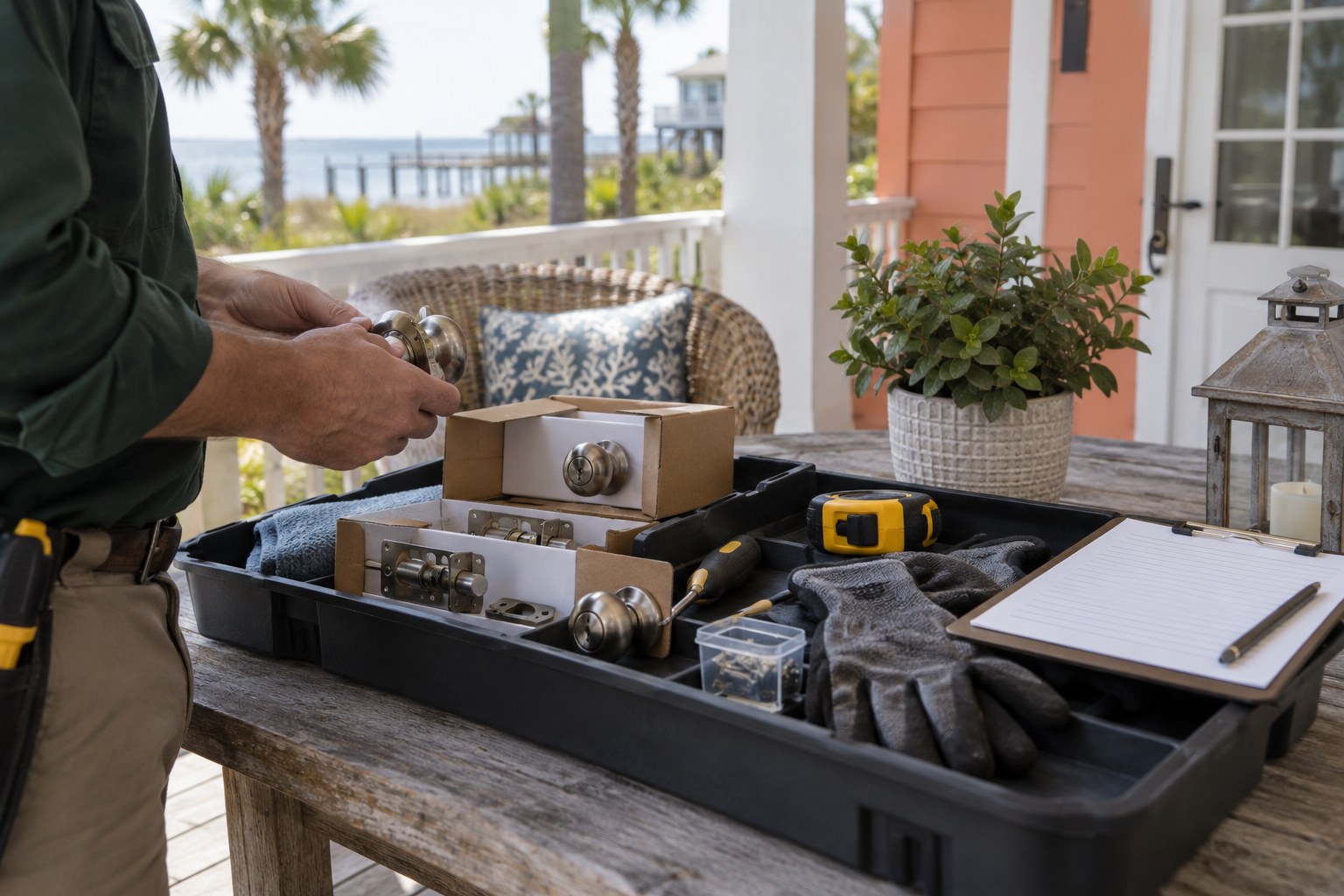
Why people replace a front door lock in the first place
Most front door replacements fall into a few honest categories. The lock is worn out after years of daily use, the finish has pitted from salt air, the key has started to bind, or the household wants better hardware than the builder installed. Others come after a break-in attempt that damaged the cylinder or the latch, or after a move when the owner simply wants new hardware with fresh keys.
It helps to separate replacement from repair and from rekeying. Rekeying changes the internal pins so old keys stop working while the lock body stays. Repair fixes a specific fault such as a loose handle or a dragging latch. Replacement means the whole lock set comes off and a different one goes on. A technician will usually tell you which of the three your situation really needs.
Sometimes the lock itself is fine and the real trouble is the door. A swollen slab, a sagging hinge or a frame that has shifted can make a healthy lock feel broken. Replacing hardware in that case only hides the symptom for a few weeks. Part of the visit is working out whether the lock is the actual cause, so you do not pay for a part you did not need.
What gets measured before anything is ordered or installed
Residential entry doors follow common standards, but homes in the Pensacola area span decades of building styles, so nothing should be assumed. The technician measures the bore hole diameter in the face of the door, the edge bore for the latch, and the backset, which is the distance from the edge of the door to the center of the main hole. Two common backset distances exist, and mixing them up leaves the knob too close to the frame or too far from it.
Door thickness matters too. Most entry doors are a standard thickness, but older or custom doors can be thicker or thinner, and a lock designed for the common size may not clamp properly. The tailpiece and screw lengths must reach through the slab without crushing it. Measuring first is much faster than discovering a mismatch halfway through the job.
The technician also checks the existing prep for cracks, oversized holes and old repairs. A door that has had several locks over the years may have enlarged holes that a new lock cannot grip. Cover plates, trim rings or a reinforcement insert can sometimes solve this, but it is better to know before the old lock comes out. A clear picture of the door shapes the whole quote.
- Bore diameter in the face of the door
- Backset distance to the edge bore
- Door thickness and any decorative inlay
- Condition of the edge, hinge side and strike side
Latch types, deadbolts and the choice between a knob set and a handle set
A front door often carries two separate locks: a latch set in the handle or knob that holds the door closed, and a deadbolt that actually resists force. The latch set alone is not meant to secure a house. If your door has only a spring latch, replacing it is a good moment to add a deadbolt, provided the door has the thickness and edge space to take one.
Handle sets, which combine a lever or grip with a thumb latch and a deadbolt, are popular on front entries. They look good, but they use a pair of bores and need enough room on the door face. Single cylinder deadbolts have a key outside and a thumb turn inside. Double cylinder versions need a key on both sides, which can be a safety problem in a fire if the key is not within reach, so a technician will talk through that tradeoff honestly.
Lever handles are easier on hands that struggle with a round knob, and they are worth considering for anyone with arthritis, small children carrying groceries, or older relatives. The choice is partly about security and partly about everyday comfort. A good installer asks how people use the door before suggesting hardware, rather than pushing whatever is in the truck.
Inspecting the door, the frame and the strike
A lock is only as strong as the wood around it. Before fitting new hardware, the technician looks at the strike plate, the jamb behind it, and the screws that hold it. Short screws that only bite into thin trim are a frequent weakness. Long screws that reach the framing stud behind the jamb make a noticeable difference to how the door resists a hard push or kick.
The gap between door and frame is another clue. Even spacing along the latch side means the door hangs well. Uneven gaps, a rubbing top corner, or a latch that only catches when you lift the door suggest a hinge problem. Tightening or shimming hinges may solve it, and that can be done during the same visit so the new lock engages cleanly.
Cracked jambs deserve attention. If the wood around the strike has split from an earlier forced entry, new hardware will sit in damaged material. A reinforcement plate or a repair to the jamb may be recommended. In some cases a carpenter is the right next call, and an honest locksmith will say so instead of installing a good lock into a frame that cannot hold it.
Coastal conditions and what they do to entry hardware
Pensacola sits beside warm salt water, and that air travels well inland. Humidity and salt speed up corrosion on exposed metal, so a front door lock facing the weather works harder than the same lock in a drier region. Finishes that look fine on a showroom shelf can pit, tarnish or stiffen within a few seasons. This is the most practical local reason to think about material rather than only appearance.
Solid brass and stainless components tend to handle moisture better than thin plated steel, and sealed internal mechanisms resist the grit and damp that foul cheaper cylinders. Homes close to the bay, the beaches or open water see the harshest conditions, but even neighborhoods several blocks back feel the effect. Covered entries help, and uncovered doors facing prevailing weather need tougher hardware.
Hurricane season adds another consideration. Doors can swell or shift after heavy rain, and wind driven water can find its way into a cylinder. After a major storm, it is worth testing every lock on the house. A key that turns stiffly, or a deadbolt that no longer throws fully, is a sign to have the door and the lock looked at before the next weather event arrives.
Keys, cylinders and what to expect from the new set
A new lock arrives with its own keys, and the household needs to decide how many it wants and who will hold them. Handing a copy to a neighbor, a dog walker or a family member is common, so it is worth thinking about this before the install. Extra keys are easiest to cut during the same visit, because the technician already has the lock open and the code in hand.
If you also have a deadbolt or a back door lock, you can ask for them to be keyed alike so the family carries one key instead of three. This is a convenience choice with a small tradeoff: one key now opens several doors, so losing it matters more. Some owners prefer separate keys for outbuildings or for a rental unit on the same property, and that is also easy to arrange.
Higher security cylinders resist picking and bumping better than basic ones, and some use restricted key blanks that cannot be copied at a hardware store counter. The tradeoff is that duplicates are only available through an authorized source, which is slower. It is worth deciding in advance whether that control matters to you, particularly if the home is a rental or if several people come and go.
How the installation is actually done
The old lock comes off first, with the technician noting which parts fit together so nothing is forced. The latch is withdrawn from the edge, the cylinder or knob is separated from the through bolts, and the bare door is inspected once more. Any splintered wood around the edge bore is addressed before the new latch goes in, because a clean seat is what keeps the bolt moving smoothly for years.
The new latch is fitted into the edge bore and the faceplate is set flush. If the plate sits proud or recessed, the door will rub or the latch will fail to align. Next the exterior and interior halves are joined with the through bolts, tightened evenly so the cylinder does not bind. Over tightening is a common amateur mistake that makes keys stiff, so the technician checks the feel of the key at each stage.
Finally, the strike plate is aligned with the new latch and secured with long screws. The door is closed and tested repeatedly: key from outside, thumb turn from inside, bolt fully extended and fully retracted. The technician watches the bolt sliding into the strike hole to see that it throws the full distance. Only when everything feels smooth does the job count as finished.
Ownership, access and what to have ready
Before opening, rekeying or replacing a lock, a locksmith checks that you own the home or have the authority to change its locks. A tenant may need the landlord's approval, and a caretaker or relative may be asked for some proof of their role. This is not a hassle for its own sake. It protects residents from someone with no rightful claim ordering their locks changed.
It also helps to gather what you can before the visit. Know how many doors need work, whether the front door has a separate deadbolt, and whether any keys have gone missing. Photos of the current lock and the edge of the door are useful when you call. Mention if the door is metal, fiberglass or wood, since that changes how holes are drilled and which fasteners are used.
Quotes are given by phone based on what you describe. If the job turns out to be complicated, for example a damaged frame or an unusual door, a technician visits and the service call charge is explained before dispatch. Call us to confirm availability for your area and to talk through the options. Clear information up front keeps the visit short and the result predictable.
When a front door lock fails at a bad moment
Locks rarely fail at convenient times. A key snaps off in the cylinder on a rainy evening, a thumb turn spins without moving the bolt, or the handle comes away in your hand while you are carrying bags. In these moments the instinct is to force it, and that instinct usually turns a small repair into a replacement. Stopping and calling for advice is almost always the better move.
If the lock is still working but feeling rough, treat that as a warning rather than a nuisance. Internal parts wear unevenly, and the day a worn spring finally gives way tends to be the day you are running late. Planning a replacement while the door still locks lets you choose hardware calmly, instead of accepting whatever can be fitted during an emergency.
Call us to confirm availability when a lock has already failed. Describe exactly what happens: does the key go in, does it turn, does the bolt move, is the door open or shut. These details let the technician bring suitable parts and tools, which shortens the visit and avoids a second trip for something that could have been anticipated.
Matching the lock to the household
A single person in an apartment style home, a family with teenagers, a landlord with a tenant on the property and a retired couple with grown children visiting all use a front door differently. The right lock for each is not necessarily the most expensive or the most elaborate. It is the one that suits who will operate it, how often, and what happens when someone forgets a key.
Households with young children often prefer a thumb turn placed where adults can reach it quickly but small hands cannot easily manage. Households with elderly relatives may value lever handles and larger key heads. Homes with frequent guests or helpers may want a keypad deadbolt instead, which is covered on its own page, so a plain key is not the only way in.
Think about the worst day as well as the usual one. If someone has a medical emergency, can responders enter quickly? If you are away, can a trusted person get in without a hidden key under a pot? Good hardware choices answer these questions in advance. A short conversation with the technician about daily habits often shapes the best recommendation.
Maintaining the new lock so it lasts
A new lock still needs a little care. Every few months, wipe down the exterior face and the keyway, and test the deadbolt with the door open to feel whether it slides without catching. A bolt that needs a shoulder shove to engage is telling you the door has moved or the strike needs adjusting. Catching this early is cheaper and easier than waiting for a lockout.
Use dry graphite or a lubricant made for lock cylinders, and use it sparingly. Heavy oils attract dust and sand, which is plentiful near the coast, and the resulting paste can jam pins. Avoid spraying household lubricants straight into the keyway. If a key starts to stick even with clean hardware, a technician can look at the cylinder before it fails completely.
Pay attention to the keys themselves. A worn or bent key puts extra strain on the pins and can eventually break inside the cylinder. Cut fresh copies from the original rather than from a worn copy, because small errors multiply with each generation. Keeping a spare in a safe location away from the door will save you from the kind of lockout that tempts people to try risky fixes.
Questions people ask us
How do I know if I need a new lock or just a repair?
If the lock turns smoothly, the keys work and the only issue is a loose handle or a dragging latch, a repair or adjustment may be enough. If the cylinder is worn, corroded, damaged in a break-in attempt, or you want better hardware, replacement makes sense. A technician can tell you which applies after a quick look.
Will a new lock fit the holes in my existing door?
Usually yes, because most entry doors use standard bore sizes and backset distances. The technician measures first to confirm. Older or custom doors, or doors with enlarged holes from past locks, may need cover plates or reinforcement so the new hardware sits firmly and operates smoothly.
Do I need a deadbolt as well as a knob or handle set?
A latch in the handle holds the door shut but is not meant to resist force. A deadbolt adds a solid steel bolt that extends into the frame. Most homes benefit from having both, provided the door is thick enough and has enough edge room to take one properly.
Do you need proof that I own the home?
Yes, a locksmith checks ownership or authority before opening, rekeying or replacing locks. Tenants may be asked for landlord permission. This protects residents and keeps the work legitimate. Call us to talk through what is acceptable in your situation before the visit.
Does salt air really affect my front door lock?
It does. Humidity and salt in the Gulf Coast air speed up corrosion on exposed metal, which can stiffen cylinders and pit finishes. Choosing corrosion resistant materials, keeping the keyway clean and avoiding heavy oils all help the lock last longer, especially on doors that face the weather.