
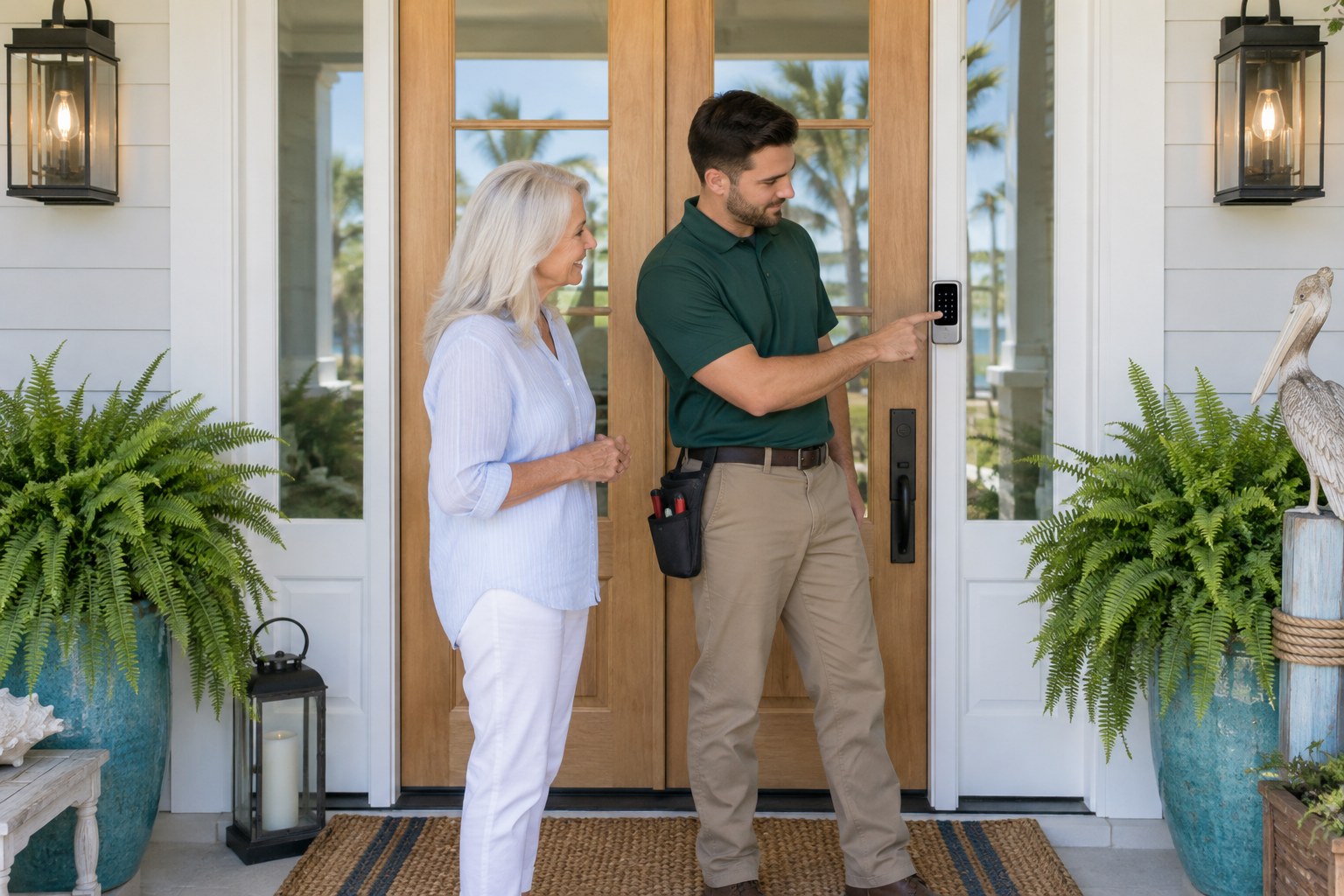
Why codes get forgotten
A keypad code is easy to remember when you use it every day and surprisingly easy to lose when something changes. A new lock installed over the weekend, a code changed after a guest left, a long vacation, or a lock that was set up by a landlord or a previous owner can all leave you at the door with a blank mind and a row of numbered buttons.
Stress makes it worse. Standing outside in summer heat or an evening thunderstorm, with groceries in your hands, is not when memory works at its best. Many people also use more than one code across a house, a gate, a garage and a phone, and the numbers blur together.
Another cause is typing the right code in the wrong way. Some locks need you to press a lock or enter button first, or to wake the keypad with a touch. Others have a timeout between presses. A code you know perfectly well will fail if the lock expects a different sequence.
Before assuming the worst, take a breath and try the simple things in the next sections. Most of the time, you can get in without damaging anything.
Try the obvious places first
Think about where the code might be recorded. Many locks come with a card that lists the master or programming code, often tucked inside the manual or the box. Check a drawer where manuals are kept, a file of home paperwork, or an email from the installer or manufacturer. The card may have a default code that was never changed.
Ask everyone in the household, and anyone who may have set the lock. A partner, a roommate, a property manager, or a relative who installed the lock may remember the code. If you rent, the landlord or manager often keeps a record of the code or the programming card.
Check your phone. If the lock has an app, your codes may be listed there, or you may be able to create a new one from the app. Password managers and notes apps are common places people store door codes. A smart speaker or a family chat might hold a hint as well.
If none of that works, move on to a reset, but first take care not to lock yourself out of the reset process by entering many wrong codes in a row.
Careful with repeated wrong tries
Most keypad locks have a safety feature that locks the keypad for a while after several wrong attempts. The lock may beep, flash red and ignore the buttons for a minute, five minutes, or longer. This protects you from someone guessing, but it also makes your own guesses costly.
Do not keep trying random numbers in the hope of hitting the right one. You may trigger a longer lockout, and some models send an alert to a connected phone or sound an alarm. If the lock has an alarm mode, it can be loud and embarrassing in a quiet neighborhood.
Write down any attempts you make so you do not repeat them. Try the likely combinations once each: the default code, a birth year, an address number, a phone number ending. Stop after a few tries and wait out any lockout.
If you reach the lockout stage, put the keypad aside and use another way in, or move on to a reset procedure suitable for your model.
- Check the manual, box or installer paperwork
- Ask household members and the property manager
- Look in the lock app or a password manager
- Stop guessing once the lockout begins
Using the key backup
Almost every keypad deadbolt has a mechanical backup. Look for a small cover on the faceplate that slides, lifts or pops off, revealing a regular keyhole. Others hide the keyhole behind the keypad itself, or have it on the edge of the housing. If you have the key, this is the simplest route inside.
A key backup does not change your code. Once inside, you can look for the programming steps in the manual, or reset the code from the inside of the lock, where the control buttons sit under the battery cover. You may need the master code for some changes, and a reset may be needed to remove it.
If you cannot find your key, think about spares. Many households keep a spare with a neighbor, a family member or in a lockbox. Check pockets, bags and car glove boxes before calling for help.
If the keyway is stiff, a small puff of dry lubricant can help. Avoid forcing a key, since a broken key creates a bigger job than a forgotten code.
How resets usually work
Reset methods vary widely between brands, but the idea is similar. Most locks have a small reset button on the inside, under the battery cover or on the back of the interior housing. Holding the button for several seconds, sometimes while the batteries are removed or replaced, returns the lock to factory settings.
A factory reset erases every user code and restores a default programming code, which the manual lists. After resetting, you set the master code first, then add user codes. If the lock has an app, you may have to pair it again.
The reset button is on the inside of the door, so you must be inside to use it. If you are locked out, you generally cannot reset the lock from the keypad side. That is a security feature, so a stranger cannot reset your lock from the porch.
If you cannot find the model or the manual, a photo of the lock and its label helps a technician identify the proper procedure.
How a locksmith helps with a forgotten code
When there is no key and no reset available from outside, a locksmith can open the door. First the technician confirms that you live at the home or have authority over it. Then they look at the lock, because the method depends on the brand and style.
Many keypad locks have a standard backup cylinder that can be picked or bypassed. Some models can be powered from outside, and others can be bypassed at the latch. These methods usually leave the lock and door unharmed.
If the lock is damaged, tampered with or unusually secure, the technician may need to remove the exterior assembly to reach the bolt. In rare cases drilling is needed. The technician explains the options before starting.
Once inside, the technician can reset the lock, set a new code, replace worn parts or install a different lock. They can also cut a spare key for the backup cylinder.
Choosing a code you will remember and others cannot guess
A good code balances memorability and security. Avoid the obvious choices that thieves try first: one two three four, repeated digits, the last four digits of your phone, a birth year or the house number. These are the first guesses anyone makes at a keypad.
Pick a pattern that means something to you but not to outsiders, such as a sequence from an old address or a date few people know. Longer codes are stronger, and many locks accept six to eight digits. A longer code is harder to guess and not much harder to remember.
Notice wear patterns too. Over time, the most used buttons can show smudges or scuffs, which hint at the digits. Wipe the pad occasionally, and consider a lock with a scramble feature or a random decoy digit entry.
Change the code when people leave your life or your home, such as an ex partner, a former roommate or a contractor. That is simple and avoids the hassle of rekeying.
Storing codes safely
Write the master code somewhere safe, but not on the door frame, the back of a pad or a sticky note by the entry. A locked drawer, a safe, or a password manager are sensible places. Keep a record of the lock model and the reset procedure, too.
Share codes only with people who need them, and create a separate code for each person when your lock allows it. If a cleaner, a contractor or a pet sitter has their own code, you can delete it without affecting anyone else.
Tell trusted family members how to reach you or a second person who knows the master code. In an emergency, the ability to reach someone with the answer can save time and trouble.
Review user codes a few times a year. Remove old ones, and confirm that the master code is still known and works.
Rentals, short stays and shared homes
In rentals and shared homes, codes pass through many hands. A landlord may change the code between tenants, guests may share it, and housemates may set their own. If you rent, ask the manager for the current code and the process for resets, and do not change the lock without permission.
For short stay rentals, a lock that allows temporary codes is helpful. Each guest gets a code that expires at checkout, and the master code stays private. If your lock lacks that feature, change the code between stays.
If a tenant has forgotten the code and the landlord cannot be reached, a locksmith can still open the door after the tenant proves residence. Work beyond opening, such as rekeying or replacing the lock, normally needs the owner's approval.
Keep a note of any changes so the next person knows what to expect.
Calling in help when the keypad code has slipped your mind
Call if there is no key, no way to reach someone who knows the code, or the lock has gone into lockout. Tell us the brand and model if you can read it, what the lock does when you press a button, and whether you have tried a reset or a key.
Photos of the keypad, the faceplate and any labels help. A quote is given by phone for common work, and availability should be confirmed on the call. If the job is complicated, a technician visits first, and the service call charge is explained before dispatch.
Please be ready to confirm ownership or authority over the property. This check is done for every customer and protects the household.
If you would like a different lock, a different style of code entry or a keyed backup matched to your other locks, mention it during the call.
Different styles of keypad, different habits
Not all keypads look or behave alike. Push button models, often found on older homes and some gates, use a row of mechanical buttons that you press in a set order, and many have no battery at all. Forgetting the sequence on one of these is common because the combination can be changed by moving small internal pins, and there may be no obvious sign of what it is.
Touchscreen keypads wake up when your hand approaches, show a lit number grid and often have a separate lock button on the outside. The glass can fog in humid air, and fingerprints can show which digits are used. If the screen looks dull or blank, replace the batteries before assuming the code is the issue.
Hybrid designs combine a keypad with a fingerprint reader or a card tap. If your lock offers more than one way in, try the other methods before anything else. A registered fingerprint or card may open the door while you work out the code, and you can then fix the keypad from inside.
Knowing which type you own helps the technician as well. A quick description such as a numbered push button lock or a lit touchscreen lock narrows down how it can be opened and what a reset would involve.
Preventing the next lockout at the keypad
The best fix is a small system. Choose one person in the household to hold the master code and the programming card. Keep a spare key in a safe place that is not at the door. Add a second way in, such as a fingerprint or a code that is easy to share temporarily, so that one forgotten number never means a locked door.
Write the code in a form only you would understand. A reminder can be a hint, not the code itself, such as a word that brings the digits to mind. Avoid storing the full number in the notes app of a shared device, or in a place visible to visitors.
Replace batteries on a schedule and keep the manual with your home records. A lock that fails to wake up is often mistaken for a forgotten code, and a quick battery swap can save a call. Mark the date on the inside of the door when you change them.
Finally, test the system when you are not in a hurry. Lock the door, step outside, and enter the code. Check that your key works too. Ten minutes spent on a calm afternoon prevents a stressful moment later.
Setting up a code policy for people who come and go
Once the immediate lockout is over, a household can use the moment to decide how codes should work from now on. A family code that everyone shares is easy to remember but impossible to track. Individual codes, where the lock supports them, make it clear who entered and let you remove one person without disturbing the others. Decide how many codes the household really needs, who gets them and how long each is meant to last.
Temporary access deserves a plan of its own. A cleaner, a plumber, a guest or a house sitter may need entry for a day or a week. Give them a code that you can delete afterwards, and note the date on which it should end. Write that date on a calendar, not just in your head. Many forgotten and overlooked codes remain active for years simply because nobody remembered to remove them, and that gap undermines the entire reason for using a keypad.
Choose codes with some thought. Avoid birth years, street numbers and repeating digits, since those are the first things anyone would try. Pick something with meaning only to you, and avoid writing it on or near the door. If you must keep a record, store it with other important papers, not in a note on your phone labelled with the house name. And if the lock allows it, turn on a lockout delay after several wrong entries. We can help configure that and test it with you, so that the rules are working before you rely on them.
Privacy and security when someone else knows the code
A code that has been shared widely is a weak lock. People move, relationships change and codes are passed along without anyone noticing. If you suspect the code is known to people who should not have it, change it today, whether or not you forgot it. A forgotten code is a convenient reason to review who has access.
Watch for signs of misuse. Many connected locks keep a log of entries, which can reveal when and by which code the door was opened. If your lock has no log, notice unusual patterns, such as the door unlocked when you left it locked, or small items that seem moved.
If a code was shared with a worker or a short term guest, delete it right away when the job is done. Create unique codes whenever the lock allows it, so each person is traceable and removable without disturbing the others.
If you feel unsafe, a locksmith can rekey or replace the lock and set up a fresh code, and can talk through ways to improve entry security, such as a stronger strike plate and a better deadbolt.
Questions people ask us
Can I reset a keypad lock from outside the door?
Usually not. Reset buttons are on the inside for security. If you are outside and have no key, a locksmith can open the door, and then you can reset the lock from inside.
Will a factory reset erase all my codes?
On most locks, yes. It clears all user codes and restores defaults. You then set a new master code and add user codes again, and in some cases pair the lock with an app.
What if I tried too many wrong codes?
The keypad may lock out for a set time. Wait for the lockout to end, and avoid more guesses. Use the key backup or call us if you need to get in sooner.
Can you find out my code?
We do not read codes from locks. We open the door, and reset or replace the lock so you can set a new code. Ownership is confirmed before any work.
How often should I change my keypad code?
Change it when someone who had it should no longer have access, and consider changing it once or twice a year. A longer code is safer than a short one.