
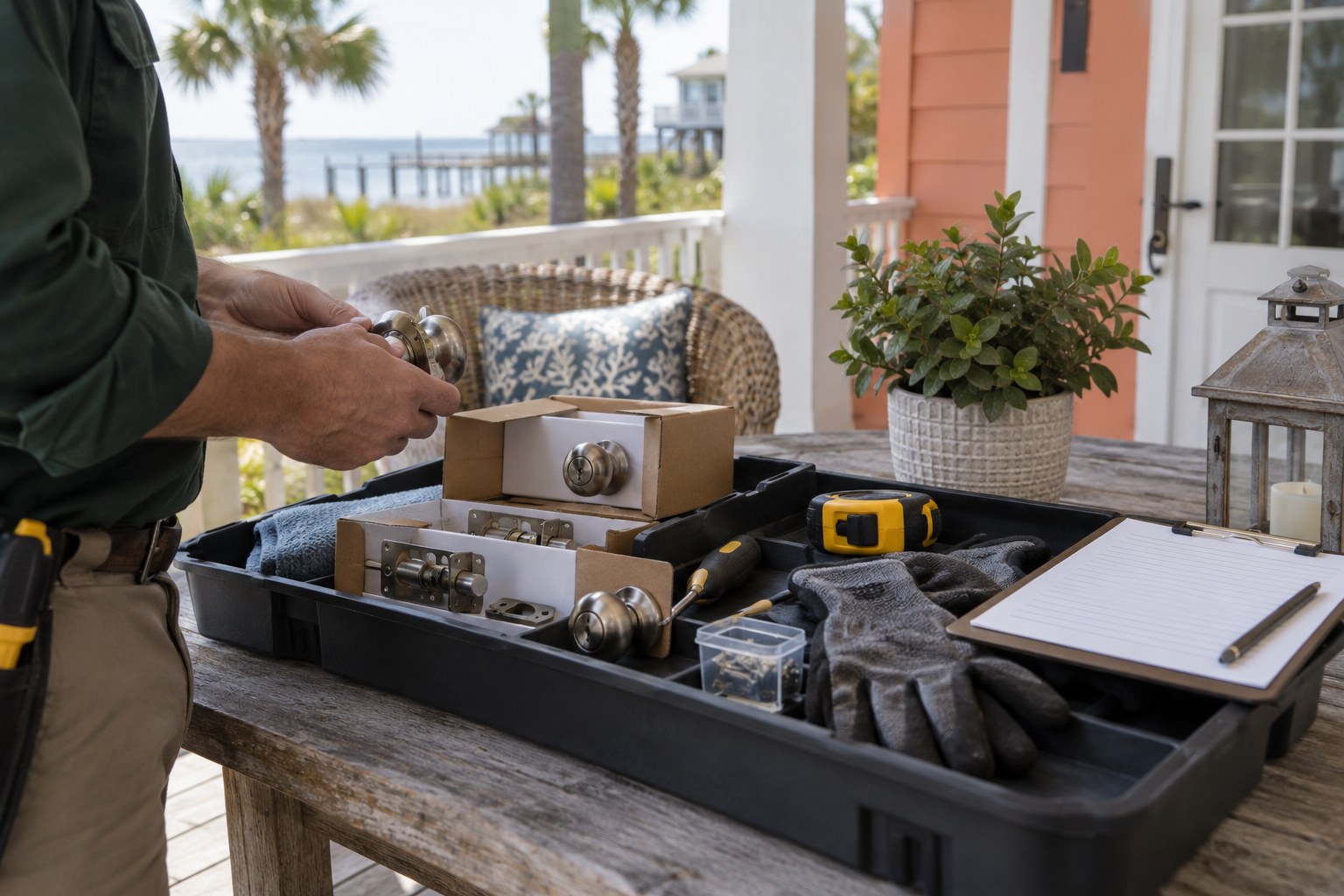
How salt actually gets onto your door
Salt reaches a door in several ways. Surf and wind throw a fine mist of seawater into the air, and onshore breezes carry it inland. Storms push larger amounts farther still. Bay breezes bring their own spray. The salt lands as an invisible film on handles, hinges, strike plates, and keyholes, then draws moisture from the air and stays damp.
Distance from the water matters, but not as much as people expect. A house a few blocks back may still see a steady film of salt, especially in the open or on the windward side. Homes directly on the beach or the bay get the heaviest dose. A door facing the water takes more than one facing away from it, and a covered porch slows deposits but does not stop them.
Salt itself is not the whole problem. It makes a conductive layer that speeds up electrochemical corrosion between different metals. Brass screws in a steel plate, or a plated lock on an aluminum frame, set up small batteries that eat the weaker metal. Moisture, salt, and mixed metals are a hard combination for any hardware.
Seeing the process helps you target your effort. You cannot stop salt from arriving, but you can choose materials that tolerate it, rinse it away before it does harm, and keep protective finishes in good shape.
Look around your own property for clues. A white crust on car chrome, rust streaks on a metal mailbox, or a film on outdoor windows tells you how heavy the deposits are. The same pattern is working on your door hardware. Use these signs to judge how often you need to clean and how much to invest in durable materials.
What corrosion looks like at each part of a door
Hinges often show trouble first. Look for rust streaks running down from the pin, a squeak when the door moves, and flaking paint-like finish. Pins can seize or wear, letting the door sag. Screw heads turn orange or white and strip when you try to tighten them. A hinge in this state is already failing.
Handles and levers show pitting and a rough feel. Brushed or plated surfaces lose their coating in patches, exposing darker metal. The spring inside a lever can rust, so the handle droops or does not return. Knobs may loosen on their spindles as corrosion works into the set screws.
The lock itself suffers inside. Keyways collect salt crystals that make the key gritty. Springs and pins corrode, and the key turns harder. Deadbolt latches may stick partway, and a bolt that does not throw fully is a security problem. Strike plates rust and stain the frame, and their screws weaken.
Weather exposure compounds everything. The outside face of a door gets the worst of it, while the inside face is gentler. If you can compare the two sides of a handle set, you will often see the difference clearly. That comparison shows how much the environment is costing you.
Take a flashlight and a magnifying glass if you have one. Hairline pitting, early rust at screw heads, and small bubbles under a finish show up before the damage becomes obvious. Catching these signs early lets you clean, treat, or swap a single part rather than the whole set, and it keeps the door operating smoothly while you plan.
Choosing finishes that stand up
Not every finish is built for the coast. Thin plated coatings, such as bright chrome or cheap brass plating, are the first to fail. Once salt penetrates the plating, the metal underneath rusts and the coating lifts off. If you can see a flaky edge, the plating is already compromised.
Better finishes use thicker layers or different materials. Solid brass develops a natural patina but keeps its strength. Stainless steel resists rust well, particularly in grades made for marine use. Some hardware uses a physical vapor deposition coating that is hard and durable. Powder-coated finishes resist moisture when applied thickly and evenly.
The best choice depends on your priorities. Appearance, cost, and exposure all matter. For doors facing the water, spend more on a robust finish. For sheltered or interior doors, standard finishes may be fine. A technician can recommend options for your situation, and can match finishes across door sets so the home looks consistent.
Remember that the finish on the screws and fasteners matters as much as the lock. A stainless lock held by cheap zinc screws will still stain and fail at the fasteners. Ask for matching stainless or brass screws, and use them everywhere the hardware meets the door or frame.
Be wary of marketing words. Terms such as weatherproof or rust resistant mean different things from one maker to another, and they rarely describe how a finish performs in constant salt exposure. Ask for the actual material, whether solid brass, stainless steel, or a coated base metal, and judge from that. A technician can explain what a given lock is really made of.
A rinse-and-wipe routine that actually helps
The simplest defense is also the least costly: remove salt before it does damage. Every few weeks, especially after windy or stormy weather, wipe handles, locks, and hinges with a cloth dampened in fresh water. Dry them with another cloth. This takes less than a minute per door and removes the film that feeds corrosion.
For doors that face the water, a rinse is better still. A gentle spray of fresh water from a hose, followed by a dry wipe, clears accumulated salt. Avoid blasting with a pressure washer, which can force water and grit into the lock. Keep spray away from keypads and electronic parts.
After a storm, rinse right away. Heavy salt deposits from storm winds are the most damaging, and leaving them for weeks multiplies the harm. Make the rinse part of your cleanup, along with checking shutters and clearing debris. It is a small step that pays back for years.
Add a light protective step now and then. A thin coat of a quality wax or a clear protective spray on exterior handles and plates, applied to a clean, dry surface, slows salt contact. Do not apply it to the keyway or moving latch. Check the manufacturer's advice for the finish you have.
Lubricating the right way near the coast
Salt air makes lubrication choices matter more. Heavy oils and greases pick up sand and salt crystals and form an abrasive paste. For keyways and cylinders, use a dry lubricant such as graphite or a silicone spray made for locks. A light application, worked in with the key, is enough.
For hinges, a small amount of silicone or light grease on the pin helps. Wipe off any excess that could collect grit. If a hinge squeaks, lift the pin slightly and apply lubricant to the barrel. A tidy hinge lasts longer than a messy one.
Latches and deadbolt bolts benefit from a thin touch. Extend and retract the bolt several times after lubricating to spread the product, then wipe the bolt with a clean cloth. If the bolt drags, the problem may be alignment rather than lack of lubricant, and adding more will not help.
Make lubrication a seasonal habit rather than a reaction. Twice a year is a good rhythm. Combine it with a check of screws and a look for rust. In this climate, preventive care costs very little compared with replacing hardware that failed early.
Keys themselves need care. A key that carries salt and grit from your pocket or a beach bag spreads it into the keyway every time you use it. Wipe your keys now and then, keep them out of wet swim bags, and replace any that look worn. A clean key is one of the easiest ways to protect the lock.
Electronic locks and salt
Keypad and smart locks suffer from salt in a different way. Moisture and salt reach battery contacts and circuit boards, causing corrosion that appears as flickering lights, slow response, or buttons that fail. Seals and gaskets help, but they wear out. Look for locks designed for outdoor and coastal use.
Keep the keypad and the escutcheon clean. Wipe them with a damp cloth when you wipe the handles, and dry them. Avoid spraying cleaners directly onto the keypad. When you change batteries, check the contacts. A white or green crust means corrosion has begun, and cleaning gently with a soft brush can help.
Plan for the lock's limited life in a harsh spot. Even a well-made electronic lock may need replacement sooner on a beachfront door than inland. Budget for it, and keep a mechanical backup key available. A key hidden in a safe place gives you a way in when electronics fail.
Place sensitive parts where they are sheltered if you have a choice. A keypad under a porch roof is exposed to less direct spray than one in the open. Small decisions about placement affect how long the device lasts.
Consider the position of the lock relative to the weather. On a door that faces the prevailing wind from the water, salt hits the hardware directly. A small awning, a deeper porch, or a screen can break up the spray. Even a modest overhang changes how much salty moisture settles on the keypad and handle.
Mixed metals and fasteners
Different metals in contact with each other corrode faster, especially when wet and salty. Aluminum frames with steel screws, brass handles on zinc plates, or stainless bolts through carbon steel brackets can create this effect. The more reactive metal degrades, and stains or pitting appear around the joint.
To avoid this, use matching or compatible metals where possible. Stainless screws with stainless hardware, brass with brass. Where you must mix, use isolating washers or a thin barrier of sealant between them. This keeps moisture from creating a bridge between the metals.
Fasteners deserve special attention. Standard zinc-plated screws rust within a season or two near the coast. Replace them with stainless steel screws of the correct size, and seal the heads of exposed screws with a drop of clear sealant if you wish. It is a small job with a big payoff.
When a lock is replaced, replace its screws and strike plate screws too. New hardware held by old, rusted fasteners will not last. A technician will typically bring suitable screws, but ask if you are unsure.
Think about sealing around hardware too. A thin bead of exterior-grade sealant where a plate meets the door keeps water from creeping behind it, where corrosion would otherwise grow unseen. Check these seals yearly. When they crack or pull away, refresh them. Good sealing can add real life to hardware without changing anything about how it looks.
Sliding doors, windows, and the rest of the house
Salt attacks more than front doors. Sliding door latches and tracks, window locks, garage entry doors, and gate latches all face the same environment. Aluminum frames resist rust but can pit and develop white powdery corrosion. Steel latches inside aluminum frames corrode and stain.
Check all exterior hardware at least once a year. Open and close each window, operate each latch, and look for crusty deposits. Clean and lubricate as needed, and replace any part that has lost its finish or feels rough. Do not neglect the less obvious locks, such as those on storage closets and outdoor showers.
Gates and fences take the worst of it. Padlocks, hasps, and latches near the water often rust within a season. Choose marine-grade or stainless products, and spray padlocks with a suitable protectant. A rusted padlock that will not open is a poor sort of security.
Treat the house as a whole. Where one door shows heavy corrosion, others will soon follow. A walk-through with a notebook gives you a clear picture, and it lets you plan replacements in order of need.
If you own a vacation property near the beach, build the inspection into your arrival routine. Spend a few minutes checking latches, rinsing salt off the handle sets, and noting what looks different from last visit. Properties that sit empty between stays can corrode quietly, and a regular look keeps small problems from stacking up.
Salt-damaged hardware that is past the point of saving
Salt air does not settle evenly on a house. Parts of a door that stay damp longest are the ones that corrode fastest, and those spots are not always the obvious ones. The underside of a lever handle, the bottom edge of a door where water runs and pools, and the area behind a screen or storm door where air barely moves are all common problem areas.
A simple walk around your house after a rain or a foggy morning will show which doors dry slowly. Look for water beads or a dull film on handles and hinges that lasts well into the day. Doors under deep porches may stay dry but collect salt dust that is never rinsed off by rain, so they can corrode in a different, crustier way.
Understanding the moisture pattern lets you decide where to spend effort. A door that stays wet is a candidate for sealed or corrosion resistant hardware and for more frequent wiping. A door that stays dry but dusty needs rinsing rather than oil. A technician can help match finishes to each location and point out gaps in weatherstripping that let moist air reach the lock body.
The point where new hardware beats cleaning
At some point, cleaning and lubricating no longer help. A lock whose key turns with difficulty despite care, a deadbolt that sticks partway, a handle that wobbles, or hinges with deep pitting are signs that the hardware is at the end of its life. Continuing to patch it risks a lockout or a failure when you need the door most.
Replacement is also a chance to improve. Choose hardware suited to your exposure, with thick finishes, stainless or brass construction, sealed internals, and quality fasteners. Matching the key across your doors reduces the number of keys you carry. A technician can rekey or replace locks to a single system, after confirming that you own the home or have the owner's permission.
Describe your situation when you call: the location, the door type, the age of the hardware, and what you notice. Quotes are given by phone, and call us to confirm availability. If the job is complicated, a technician visits and the service call charge is explained before dispatch.
A little care and the right materials let hardware live a long life even in salty air. The coast is hard on metal, but it is not impossible to work with, and a steady routine keeps your doors smooth and secure.
Keep the old hardware you remove, at least until the new set is working well. Comparing worn parts with new ones teaches you how fast your environment acts, and it can help a technician match sizes and finishes on your next job. Put the pieces in a labeled bag in a dry drawer.
Questions people ask us
How far from the water does salt air matter?
It affects more than just beachfront homes. Onshore winds and storms carry salt inland, so even houses several blocks back see a film on exposed hardware. Doors facing the water and open to wind are hit hardest.
What is the best finish for coastal door hardware?
Solid brass, quality stainless steel, and thick durable coatings handle salt better than thin plated finishes. Use matching stainless or brass screws too, since cheap fasteners rust and stain even good hardware.
How often should I clean door hardware near the coast?
A quick wipe with a damp cloth every few weeks helps, with a fresh water rinse after storms. Lubricate with a dry product about twice a year and check screws for rust at the same time.
Can I use WD-40 or oil on my locks?
Heavy oils and general-purpose sprays attract sand and salt and form a gummy paste. A dry lubricant such as graphite or a silicone product made for locks is a better choice.
When should I replace instead of repair?
If the key turns hard despite cleaning, the bolt sticks, the handle wobbles, or the finish is pitted and flaking, replacement is wiser. Call us and describe it, and we will advise honestly.