
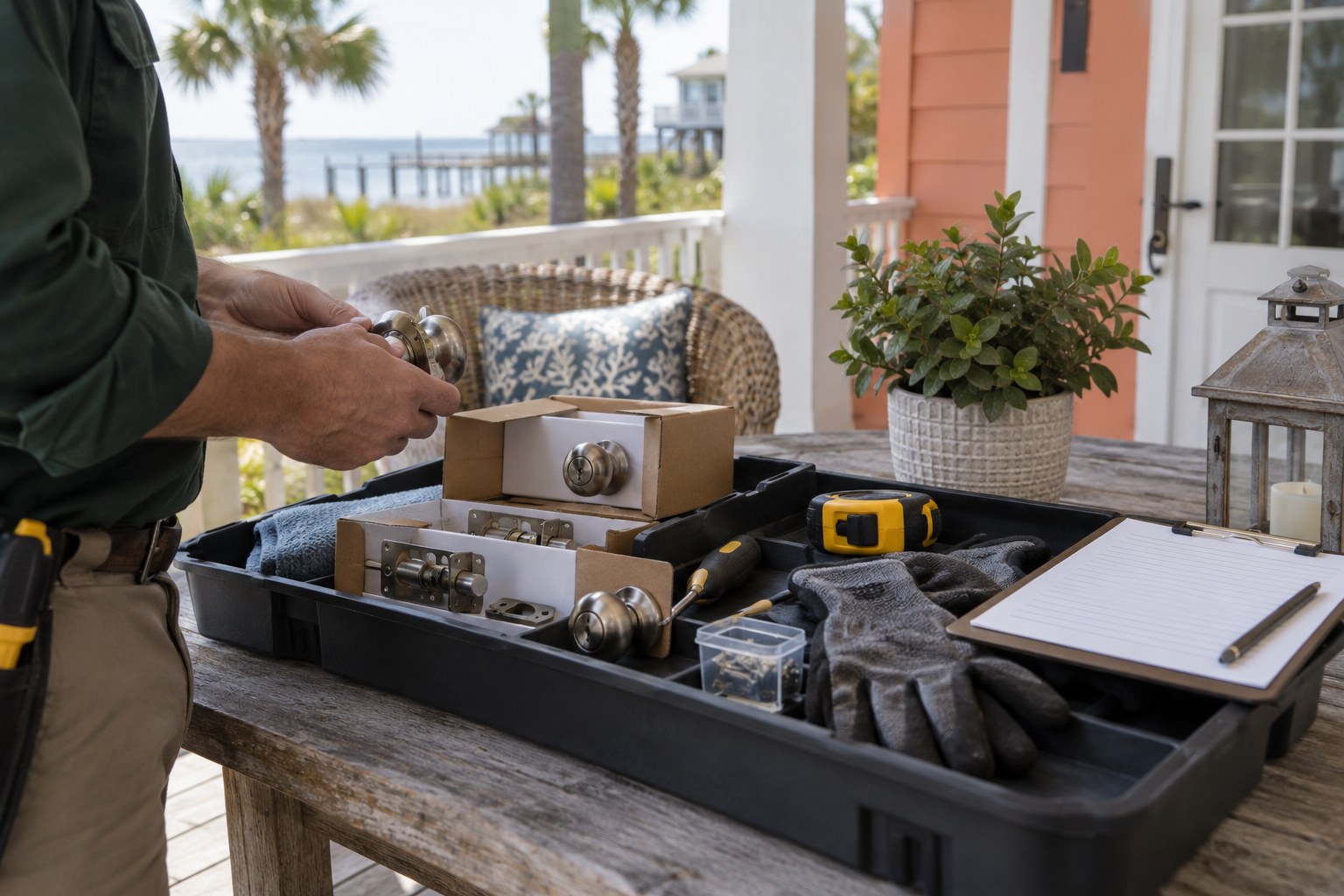
How a key copy is made
A key duplicating machine has two vises. One holds the original, and the other holds a blank. A guide follows the cuts on the original while a cutting wheel shaves the blank to match. The result is a key with the same pattern of peaks and valleys, in theory. In practice, every step introduces tiny differences.
The machine is only as accurate as its calibration. If the guide and the cutter are slightly out of alignment, every key it makes will be a little off. If the blank is clamped crookedly, the cuts will be skewed. If the cutting wheel is dull, it leaves burrs and rough edges that make the key drag in the lock.
The tolerances involved are small. A pin tumbler lock typically allows a few thousandths of an inch of error in each cut. A copy that is off by more than that at even one position will not lift the pins to the shear line, and the plug will refuse to turn. The result looks like a perfect key but behaves like a wrong one.
The original may be the real problem
If the key being copied is worn, the copy starts with a handicap. Each cut on a worn original has rounded edges and shallower depths. The machine traces those worn shapes faithfully, so the new key has the same defects, plus a little extra error from the process. Copies of worn keys are the leading cause of keys that do not work.
You can often see the issue by laying the two keys side by side. The original may have smooth, shiny cuts, while the fresh copy has sharp, bright edges. A copy can look different from the original, and that difference suggests the original has changed shape from use. The lock may be adapted to the worn key, so a technically correct copy might not feel right.
Sometimes the reverse happens. The lock has worn to match the old key, and a perfectly cut new key does not fit as comfortably. In that case the lock itself may need attention, and a technician can test with a fresh code cut key to see which part of the pair is at fault.
Blank selection and keyway matching
Blanks come in hundreds of profiles, and the shape of the groove along the key must match the keyway of the lock. A blank that is close but not exact may fit into the lock partly or not at all. It might enter but ride at the wrong angle, so the pins do not meet the cuts where they should.
Some brands use similar looking blanks that differ by small details, such as a shoulder position or the depth of a groove. Counter staff can mistake one for another, particularly with older or unusual locks. A mismatched blank gives a key that looks right and is useless.
If you suspect a blank mismatch, check whether the key goes in smoothly to its full depth. A key that stops short or binds on entry is a clue. A technician can identify the correct blank by examining the brand markings and the keyway, and can cut a replacement that fits.
Cutting depth and spacing errors
A key has two measurements for each cut: the depth and the position along the blade. Depth sets how high the pin is lifted. Spacing makes sure the cut lines up with the pin. If either is wrong, the key fails. A shallow cut leaves a pin too low, and a deep cut leaves it too high.
An error in spacing is especially troublesome. If the cuts are shifted along the blade by a small amount, each pin meets the wrong slope. The key may feel like it is going in smoothly but will not turn. It can also turn partway and then stick, depending on how many positions are off.
A technician checks a questionable copy with a key gauge or compares it to a freshly decoded key. If a cut is wrong, the key is recut or replaced. Unlike a homeowner with a rough eye, a technician can measure cuts to a fraction of a millimeter and pinpoint the problem quickly.
- Key enters but will not turn at all
- Key turns halfway and stops
- Key works only with jiggling or pulling
- Key sticks going in or coming out
Burrs, rough edges and finishing
After cutting, a key should be deburred. The cutter leaves tiny metal ridges along the edges of the cuts, and these can catch on the pins or the keyway. A freshly cut key with burrs may feel rough or stiff, and sometimes fails to turn even though the cuts are correct.
Many shops use a wire brush wheel to remove burrs. If this step is skipped, or done carelessly, the key suffers. You can sometimes improve a burred key by rubbing it gently on a smooth surface or brushing the edges, but heavy filing risks changing the cuts.
If a new copy feels gritty, do not force it in the lock. Burrs can scratch the keyway and leave shavings inside. Take it back to be cleaned or have a technician recut it. A clean, smooth key helps protect the lock from unnecessary wear.
When the lock is the problem
Occasionally the copy is fine and the lock is off. A cylinder with worn pins, weak springs or dirt inside can reject a good key. This is more likely if the original key also feels rough or needs wiggling. The lock has adapted to the old key's worn shape.
Try the new key in another lock from the same set, if you have one. If it works elsewhere, the copy is probably fine. Also test the original in the same lock. If both feel rough, the lock needs cleaning or repair.
A technician can separate the two possibilities by testing with a fresh key cut from the code. If the code cut key works smoothly, the original and the copy were the problem. If it still feels rough, the lock is the issue. That test is conclusive and prevents wasted effort.
Restricted and security keys
Some keys are restricted and cannot be copied at a typical counter. They carry stamps, special profiles or patented keyways, and their blanks are only sold to authorized dealers. A copy of such a key made on a standard blank will not work, and an attempt to force one could damage the lock.
High security keys often have cuts on the sides or tiny dimples instead of ridges. These need specialized machines. A standard copy shop cannot reproduce them, and a poorly made substitute may jam.
If your key says do not duplicate or looks unusual, call first. A technician can tell whether it can be copied, and whether proof of ownership is needed. Authority is checked before duplicating, which protects the people who rely on the key's restrictions.
Salt air, wear and everyday abuse
Coastal conditions are hard on keys. Salt air tarnishes brass, moisture roughens surfaces, and sand travels in pockets and bags. A key that has traveled through beach days, boat trips or humid garages gets worn faster than one that stays indoors.
Dirty keys make dirty copies. The duplicating machine traces the grit as well as the metal. Clean the key with a brush before copying. Remove lint, corrosion and debris, which can distort the tracing.
Treat keys gently. Avoid using them as tools, don't twist them in stuck locks, and don't drop them in sand or water. A key kept in good shape gives a better copy and extends the life of the lock.
How a technician makes a reliable copy
The process starts with the original and the lock. The technician examines the key for wear, checks the blank type, and tests the key in the lock. If the key is sound, a copy is cut carefully on a calibrated machine and deburred.
If the original is worn, the technician may decode the lock or use the key code to cut a fresh key. This produces a key that matches the lock's design, not the worn original. Copies are then made from the new key.
Each new key is tested several times in the lock, in both directions. Before cutting keys for a home lock, the locksmith confirms that you live there or have authority over it. Quotes are given by phone. If the job is complicated, a technician visits first and the service call charge is explained before dispatch.
Copying keys for rentals and short-term stays
Rental properties go through keys at a remarkable rate. Guests lose them, tenants make copies at different shops, and owners hand out spares to cleaners and contractors. Each generation of copy drifts a little further from the original, and eventually a key that looks right fails at the door on a guest's arrival night. That is an avoidable problem with a simple routine.
Keep a master key that never leaves the owner's hands, and cut working copies only from it or from the lock's code. Replace working copies on a schedule, for example at each change of tenant or after a certain number of guest stays. Label them by door and date so you know which are old. A small tag system takes minutes and prevents most of these failures.
If a guest reports a key that will not turn, do not blame the guest first. Test the key yourself. Many such reports are real copy faults, and a quick swap with a fresh key solves the problem. If the lock itself is rough, schedule cleaning or a cylinder replacement before the next arrival, so the issue does not repeat.
Mailbox, padlock and small-lock keys
Small keys fail in the same ways as house keys, but they are often cut on cheap blanks and copied carelessly. Mailbox keys, padlock keys and cabinet keys have shallow cuts and tight tolerances, so even a slight error ruins them. If a copy of such a key does not work, try a second copy before assuming the lock is bad.
Many small locks also use wafer designs, which tolerate less abuse than pin tumblers. A forced key can bend the wafers and make the lock unusable. If a copy sticks, do not force it. Withdraw it gently, check it for burrs, and try again after cleaning the key.
For locks that matter, such as a storage shed with valuable tools, cut keys from a good original and test them at the lock. Consider replacing a weak padlock with a stronger one, and keying it alike to your other locks so you carry fewer keys. A technician can set that up in one visit.
What to do when the spare fails and the original is gone
The hardest version of this problem is a spare that does not work when you have lost the original. The lock is closed, the only key fails, and you need a path forward. Start by checking whether the spare turns with extra care, a little jiggle and a gentle pull, as some marginal copies work with technique. Do not force it, as that can snap the key.
If it does not turn, a locksmith can open the door after confirming that you live there or have authority over it. The technician then reads the lock and cuts a new key from its design, so you are no longer dependent on a bad copy. This also settles whether the lock is healthy, since a good new key will show it.
Take the failing spare with you to the appointment and show it. Seeing where it deviates from the new key teaches you what went wrong, and it helps you decide where to have copies made in the future. It also lets the technician confirm the cause rather than guess.
Testing a new copy properly
A proper test takes less than a minute. Stand at the door with it open, insert the key fully, and turn it in both directions several times. Feel for any catch, scrape or hesitation. Then close the door, lock and unlock from outside, and repeat. A key that works smoothly with the door open but sticks when it is closed may be revealing a door alignment issue, not a bad copy.
Test the key in each lock it is meant for, and with each lock in each state, locked and unlocked. A key that turns easily to unlock but sticks to lock is a warning, because it may be at the edge of tolerance. Try it a second time later in the day, as heat and humidity can shift how snugly a cylinder behaves.
If anything feels wrong, return to the cutter the same day with the original, the copy and the lock if possible. Most reputable cutters will recut a key that fails. Explaining precisely what you felt, such as sticking at a certain point, helps them find the error faster than saying it simply does not work.
Checking a bad copy against the original before you blame the lock
When a duplicate fails, the quickest test is to compare it to the original side by side under good light. Hold the two keys with their blades aligned and look down the cuts. The valleys should land at the same depths and the same spacing. Even a small offset at one position can stop the key from lifting a pin to the shear line, and that is enough to make a copy refuse to turn.
Then check the original on the lock itself. If the original is only turning with effort, the copy was probably made from a key that was already worn. Every generation of copies amplifies that wear, so a key traced from a worn copy of a worn copy may be well off the original specification. This is why a fresh key made from the code or from a clean master often works when ordinary copies keep failing.
Also look at the shoulder and tip. Keys stop against a shoulder or a tip depending on their design, and a duplicate cut slightly short will sit too far in or too far out. A technician can measure that quickly, adjust or recut, and test the result in the actual lock. If you bring the original, the failed copy and any other copies, the problem is usually clear within minutes.
Tips for getting good copies
Take your best key to be copied, not the one that has been used for years. If your only key is worn, ask about a code cut or lock cut key instead. Ask the person cutting the key to test it before you leave, if the lock is available.
Check each copy before you need it. Try it in the lock when you are at home and calm, with the door open. If it sticks or needs jiggling, return it right away. Waiting until the day you need the spare turns a minor problem into a crisis.
Make a master set and a working set. Keep the master safe and use it only to make new keys. Working keys that are cut from the master stay accurate. This habit prevents the slow decline that comes from copying copies.
Questions people ask us
Why does the copy not turn the lock?
The most common reasons are a worn original, a cutting error, a wrong blank or burrs on the key. Sometimes the lock itself is worn. A technician can find which.
Can a bad copy be fixed?
Sometimes it can be recut or deburred. If the cuts are far off or the blank is wrong, a new key is better. The technician explains the best option.
Should I copy a worn key?
It is better to cut a new key from the lock or its code. A copy of a worn key inherits the wear and often fails.
Can all keys be copied?
No. Restricted and high security keys need special blanks and may require proof of authority. A technician can tell you what is possible.
How do I get a quote?
Call us and describe the key and the lock. Quotes are given by phone. If the job is complicated, a technician visits and the service call charge is explained before dispatch. Please call to confirm availability.