
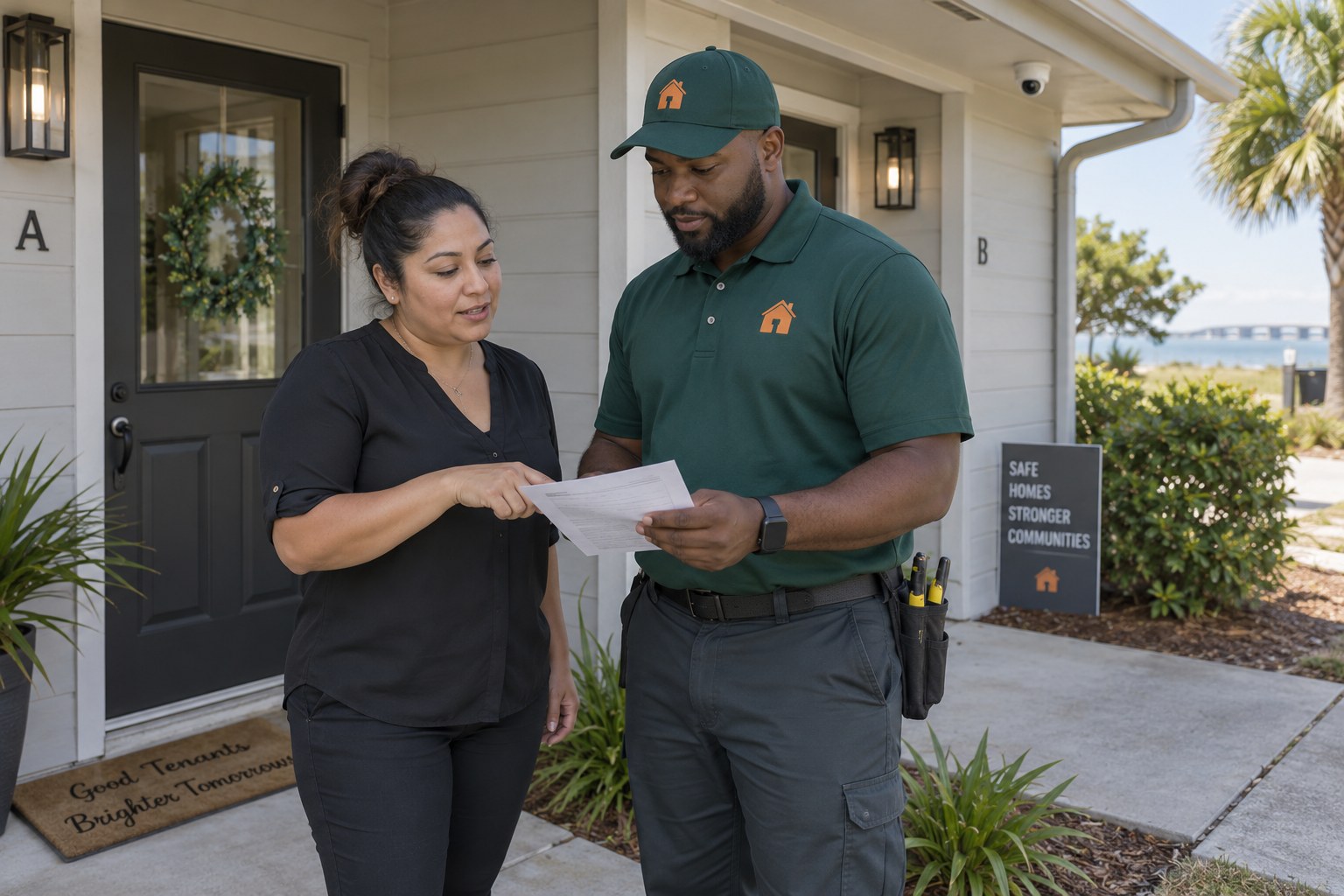
Why key control becomes harder as you grow
With one rental, you can remember who has which key. With a dozen, memory fails. Add tenants coming and going, maintenance staff, cleaners, and contractors, and the number of keys in circulation multiplies quickly. Without a system, the question of who can open what has no reliable answer.
The risk is not only theft. Lost keys, unreturned keys, and unauthorized copies create liability and tension. A tenant who finds that a former occupant still has a working key will feel unsafe, and rightly so. Good key control is a matter of professional care for the people who live behind your doors.
A system does not have to be elaborate. It needs to answer a few questions reliably: which keys exist, where each one is, who is accountable for it, and what happens when one disappears. The sections below build that answer step by step, starting with the simplest habits.
Building a key register
A key register is a record of every key. For each door, list the lock type, the keyway, how many keys were cut, and who holds each one. Add the date of issue and the date of return. A spreadsheet works, as does a paper ledger kept securely, provided it is updated every time a key moves.
Give each key an identifier that does not reveal the address. A short code stamped on the bow, linked in your register to the unit, lets you track a key without exposing where it belongs. If the key is found by a stranger, nothing on it points to a door.
Review the register on a schedule. Once a quarter, compare it against reality: count the keys in storage, confirm that those issued are still where the register says, and note any gaps. A register that is never checked is just paperwork. A checked register is an early warning system.
Secure storage for keys on hand
Keys that you hold on behalf of owners need a proper home. A locked cabinet with a controlled combination or key, kept in an office and not in plain view, is the baseline. Keys hanging on an open hook by the door, labeled with addresses, are an invitation to anyone who walks in.
Separate master keys and high-value keys from the rest. If a master key opens many doors, it deserves the tightest storage and the shortest list of people allowed to touch it. Consider a sign-out process so that every removal is recorded, along with who took it and when it returned.
Think about duplicates and spares too. A spare set stored in the same cabinet as the working set is fine, but a spare set stored off-site should be equally secure. Some managers use a second location in case of fire or flood. Whatever you choose, apply the same logging rules to it.
- Locked cabinet, not an open hook board
- Sign-out record for every removal
- Master keys stored separately with the shortest access list
- Spare sets protected as carefully as working sets
Deciding who may hold a key
Not every staff member needs every key. Give access on a need-to-have basis. A cleaner may need entry to vacant units on specific days. A maintenance technician may need a set for the units they service. Nobody needs a key to a unit with no reason to enter it.
For contractors, prefer temporary arrangements. A key issued for a job should come back when the job ends. If that is impractical, rekey the lock afterward. A contractor who keeps a working key to a tenant's home is a risk you can avoid with a modest reset after the job.
Make accountability explicit. Whoever signs for a key is responsible for it. A short written acknowledgement, even a line on a log, changes how people treat the key. Keys handled casually get lost. Keys signed for are carried carefully, and returned promptly.
Master key systems and their tradeoffs
A master key system lets one key open many locks while each lock also has its own key. For a manager with many doors, it is a convenient arrangement, since one key serves a whole building or group of units. Each tenant still has a key that opens only their own door.
The tradeoff is concentration of risk. A lost or copied master key compromises every lock it fits. The system also adds complexity to the lock itself, which can slightly reduce security compared with a single-key lock if poorly designed. Good design and tight control of the master keys address most of this.
If you are considering a master system, talk to a locksmith before committing. They can explain how many levels are sensible, how the keyways should be arranged, and how replacements are handled. Changes later are possible but can mean rekeying many cylinders, so plan carefully at the outset.
Restricted keys and copy control
Most standard keys can be copied at any hardware counter in minutes. Restricted key systems change that. The keyway is protected so blanks are not freely available, and copies require authorization, typically from the person named on the system. This makes unauthorized duplicates much harder.
Restricted keys are worth considering for properties where you want strong control: multi-unit buildings, shared entrances, or any door where uncontrolled copies would be a problem. They are not magic, and the system is only as good as the authorization process behind it.
The tradeoffs are cost and convenience. Replacement keys take longer to obtain, and the authorized person must be reachable. Think about what happens when you are unavailable and a tenant needs a copy. Plan for a backup contact so the system helps rather than blocks.
Rekeying schedules that make sense
Decide in advance when locks will be rekeyed. The obvious trigger is a tenant turnover. Other triggers include a lost key, a departing employee who held a master key, a contractor who did not return a key, or any suspicion that a copy exists.
Some managers also rekey on a calendar schedule, such as once a year for shared entrances. This is a good habit where many people have held keys over time and the records are imperfect. A scheduled reset removes unknown copies without needing to find them.
Combine rekeying with other maintenance. When a technician is on site, they can lubricate, adjust, and inspect the locks at the same visit. Bundling the work reduces disruption for tenants. Call us to discuss the number of doors and a plan, and we give a quote by phone.
Responding when a key goes missing
Have a plan before it happens. When a key is reported missing, first determine what it opens, and whether the key has any identifying mark. Check the register for who last held it. Search the obvious places, but do not delay the decision too long.
Decide whether to rekey based on risk. A lost key to a vacant storage closet may justify a lighter response than a lost key to an occupied unit. A master key that goes missing is serious and usually calls for rekeying everything it opened. When in doubt, reset.
Tell the affected tenant. Concealing a lost key erodes trust and leaves a tenant unknowingly exposed. A calm message, explaining that the lock will be reset and when, shows that you take their safety seriously. Document the incident in your records.
Electronic access for multi-door properties
Many managers now use fobs, cards, or keypad codes for shared doors. Electronic access has real advantages: access can be removed instantly, entries can be logged, and there is no key to lose. For common entrances, gates, and amenity doors, it often replaces physical keys entirely.
It also needs management. Credentials must be issued, tracked, and canceled when someone leaves. A fob that is never deactivated is the electronic equivalent of an unreturned key. Treat the system with the same discipline as a physical key register.
Plan for power loss and system failure. A door controlled by electronics should have a fallback, such as a mechanical override, and a plan for storms. Hurricane season is an obvious test. A system that works only when the power is on is not the whole answer.
Training staff and setting expectations
A system succeeds when people follow it. Explain to maintenance staff, leasing agents, and cleaners why key control matters and what the rules are. People who understand the reason are far more likely to comply than those handed a list of instructions.
Keep the rules short. Sign out keys, return them the same day, never lend a key, never leave one in a vehicle, and report a loss immediately. Rules that are easy to remember are easier to follow, and a no-blame approach to reporting losses encourages honesty.
Review occasionally. A short reminder at a team meeting, or a quick audit with an open conversation, keeps the habit alive. A property manager who treats key control as part of professionalism sets the tone for the entire team.
How a locksmith supports a key control program
A locksmith can survey your doors, identify the lock types, and recommend a path: rekey to a single keyway, introduce a master system, add restricted keys, or replace worn hardware. The survey gives you a clear picture of what you have, which is the first step to controlling it.
Before work begins, ownership or authority is checked. Have documents showing that you own or manage the properties, and tell the technician in advance who will be on site. This protects owners and tenants from unauthorized changes.
Quotes are given by phone. For complicated multi-door jobs, a technician visits first, and the service call charge is explained before dispatch. Call us to confirm availability and discuss the scope. A well-planned key program often reduces the number of calls you make later.
Hurricane season and property readiness
Along the Gulf Coast, managers prepare for storms every year, and locks are part of readiness. Before a storm, confirm that doors close and latch fully, that frames are solid, and that anyone holding a key knows the plan. After a storm, inspect each door again, since moisture and shifted frames affect fit.
Keep your key register and access lists somewhere safe from flooding and power failure. A paper copy in a secure location, or a backed up digital one, ensures you can find out who holds what even when systems are down. Recovery goes faster when information is available.
Plan for access by emergency staff and repair crews after a storm. Decide in advance who may enter damaged units and how keys will be handled. Documenting each entry keeps accountability intact in what is otherwise a chaotic period for everyone.
Handling keys for owners who live elsewhere
Many managers look after properties for owners who live out of town or out of state. That arrangement depends on trust, and key control is where trust becomes visible. Tell owners how many keys exist for their property, where those keys are stored, and who may sign them out. Clear communication prevents surprises when the owner visits.
Owners sometimes keep a key of their own. That is fine, but it should appear in the register like any other. An owner who gave a key to a relative or a neighbor months ago may not remember it. Ask directly at least once a year, and record the answer without judgment.
When ownership changes, treat the sale or transfer as a turnover event. The new owner should receive all keys that are accounted for, and the locks should be rekeyed so that the previous owner, the previous manager, and anyone they trusted no longer hold working keys. Authority is checked by a locksmith before the work is done.
Common weaknesses a locksmith often finds
The same problems show up again and again in multi-door properties. Keyways vary from door to door because hardware was replaced piecemeal. Strike plates are held by short screws that a firm kick would defeat. Back doors and side gates get less attention than front doors even though they are used just as often.
Another pattern is the unlabeled key ring. A manager inherits a ring of old keys with no record of what they open, and nobody dares throw them away. Identifying each key, matching it to a lock, and retiring the rest is tedious but valuable work.
A third is a mismatch between the lock and the door. A good cylinder in a poorly fitted door, or a deadbolt that only reaches a thin piece of frame, delivers little real protection. Looking at the whole assembly, not just the cylinder, is what separates a real review from a cosmetic one.
Auditing a key box that has quietly grown out of control
Most property managers inherit a key box rather than design one. Over time it fills with unlabeled keys, duplicates nobody remembers cutting, and keys to units that were sold long ago. An audit starts on a table with a notebook. Empty the box, group keys by door, and compare each one against a list of the doors you actually manage today. Anything you cannot match goes into a separate pile marked unknown. That pile is the real finding, because every unknown key is a door that someone, somewhere, might still be able to open.
The second step is testing. A locksmith can try each unknown key in the doors you suspect and report which ones work, which ones are worn past usefulness, and which belong to hardware you no longer own. Keys that fit nothing can be retired safely. Keys that fit a live door but were never recorded are the ones that justify a rekey, since you cannot know who else holds a copy. This takes far less time and trouble than discovering the gap after a dispute with a tenant or a departed contractor.
Finish the audit by writing down what you decided and why. A short record that says which doors were rekeyed, which keys were destroyed, and who now holds each working key gives you something to hand to a new employee or an owner who asks questions. Repeat the exercise on a calendar schedule, not only when something goes wrong. A box that gets a short look every few months rarely needs a painful cleanup, and the people who rely on it learn that keys here are counted rather than casually borrowed.
A simple annual key control review
Once a year, set aside time to review the whole program. Count keys, check storage, compare the register against actual holders, and look at the list of electronic credentials. Note anything that does not match, and resolve it before moving on.
Walk a sample of doors. Test the locks, check for wear, and note any that are due for replacement. Salt air and humidity wear on hardware gradually, and an annual look catches stiffness before it becomes a failure. Fix small issues while they are still small.
Finish by updating your policies. If something went wrong during the year, adjust the rule that would have prevented it. A key control program that improves each year steadily reduces the risk across every door you manage.
Questions people ask us
What is the first step in improving key control?
Create a key register listing every door, the number of keys, and who holds each one. Then count what you actually have and compare. Most managers discover gaps immediately, and the register gives you a base to work from.
Are restricted keys worth it for rentals?
They can be, especially for shared entrances and multi-unit properties where uncontrolled copies are a worry. The tradeoffs are slower replacement and reliance on an authorized contact. A locksmith can explain how they would work for your doors.
Should I rekey when a staff member leaves?
If they held a master key or keys to occupied units, rekeying is wise. For limited access to vacant units, a lighter response may be enough. When unsure, resetting is the safer choice.
Can a locksmith help set up a master key system?
Yes. A technician can survey your doors and design a system with sensible levels. Ownership or authority is checked before work, and quotes are given by phone. For larger jobs a technician visits first and the service call charge is explained before dispatch.
How do I keep track of electronic fobs and codes?
Treat them like physical keys: record who has each credential, cancel it when access is no longer needed, and review the list regularly. Keep a mechanical backup for power failures.