
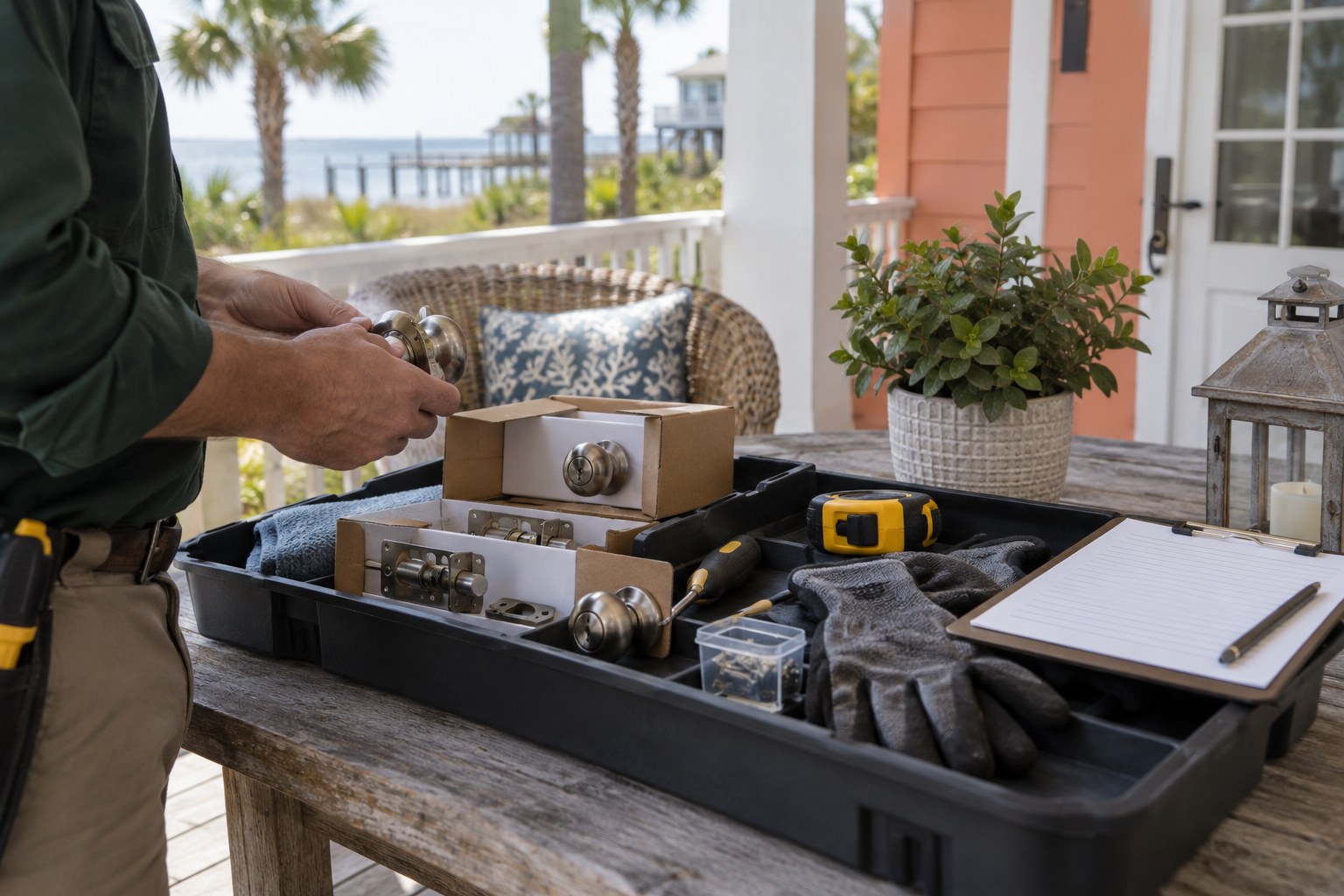
Why an empty house needs a different plan
A primary home benefits from constant use. Doors are opened and closed daily, lights go on and off, a car sits in the driveway, and neighbors see familiar patterns. A vacation home has none of that. It may sit empty for weeks, and any change in its condition can go unseen for just as long. A problem that would be fixed within a day in a lived-in house can grow for a month in a second home.
Coastal conditions add stress. Humidity swells doors, salt air corrodes hardware, and summer heat cooks plastic parts. A lock that worked perfectly last visit may stick, a keypad may fade, and a battery may drain. Because nobody tests the lock daily, the first sign of trouble is often the one that matters most.
The goal is therefore to build a plan that does not depend on you being there. Reliable hardware, controlled key access, a trusted local contact, and a short schedule of checks are the pillars. This guide takes each in turn, with a view toward small steps that you can set up once and maintain with little effort.
Be honest about your habits, too. If you tend to rush out on Sunday evening, build a closing routine that works at speed. A laminated card on the inside of the front door, listing a few steps to take before leaving, helps every family member and guest do the right thing without you standing there.
Start with a full key and access audit
List every person who can enter the house. Family members, cleaners, property managers, handymen, neighbors, previous owners, and past renters may all hold keys or codes. In a second home the list tends to be long and out of date, because people accumulate access over the years. Each name on the list is a risk you can reduce.
Collect and count the keys. Find out how many exist, where each one is, and which locks they open. If the house came with a lockbox, learn who knows its code. If you used a rental management service in the past, ask them to return their keys and codes. When the picture is unclear, rekeying is the cleanest way to reset trust.
Rekeying lets you decide who has access from today forward. A technician changes the inside of each lock so the old keys no longer work, and issues new keys. Before any rekey, the locksmith confirms that you own the home or have the owner's permission. Plan the visit for a time when you are present or when an authorized representative can meet the technician.
After a rekey, keep a simple written record: the number of keys, who has each one, and the date. Update it whenever a key moves. A small habit of recording changes protects you when the house is far away, and it is invaluable if you sell or hand management to someone else.
Choosing locks that cope with a coastal climate
Not all hardware is built for salt and humidity. Thin plated finishes flake, internal springs rust, and cheap latches seize. For a house near the beach, favor solid brass or stainless steel parts, and ask about finishes designed for marine conditions. A better lock costs more up front but often saves repeated repairs and unexpected lockouts.
Think about the doors that face the weather. A front door that gets sun and rain all afternoon, or a sliding door facing the water, ages quickly. Check the weatherstripping, the threshold, and the hinges. A door that swells or sags will not latch cleanly, and a latch that is hard to operate invites guests to leave it unlocked.
Keep lubricants simple. A dry silicone-based or graphite product works better than oil, which collects sand and grit. Apply a light amount once or twice a year. If a key feels gritty or hard to turn, do not force it. A stuck cylinder is an early warning that the lock needs attention before it fails.
Consider upgrading to a lock that tolerates neglect. Some modern deadbolts are built with sealed internals and corrosion-resistant coatings, and they handle long periods without use better than older designs. A technician can recommend suitable options and install them properly, with strike plates reinforced for stronger resistance.
If your home has an older door with a worn bore or a damaged frame, ask the technician whether repair or replacement makes more sense. Piling new hardware onto a weak door rarely gives the result you want, and an honest opinion at the start can save a second visit.
Keypads and smart locks for second homes
Keypad and smart locks suit vacation homes because they let you issue and remove access without handing out metal keys. A cleaner can have a code that works on set days, a guest can have a temporary code, and you can delete any code remotely. That flexibility is very valuable when the house is hours away.
They also demand care. Batteries run out, firmware needs updates, and Wi-Fi connections drop. If a lock relies on a network connection and the router is unplugged or the internet is off, remote functions fail. Make sure there is always a physical key backup, and test the lock after any power outage or storm.
Use strong, unique codes, not birthdays or addresses, and change them regularly. Keep a log of who has which code. Protect the account tied to the lock with a strong password and two-step sign-in. If an old account is still linked to the device, remove it. A smart lock is only as secure as the account that controls it.
Replace batteries on a schedule rather than waiting for a low-battery warning that nobody sees. Keep spare batteries at the house and note the date of the last change. When you arrive, test the lock from outside before unloading the car, so you are not caught without a way in.
Doors, windows, and openings that stay closed
Walk every exterior opening before you leave. Check that each deadbolt is thrown, each window latch is engaged, and each sliding door has its bar or pin in place. A vacation home often has many glass doors, balconies, and large windows, so the list is longer than at a typical house. Walk it in the same order every time to make it automatic.
Do not forget the less obvious openings: pet doors, attic hatches, crawlspace access panels, outdoor shower enclosures with locks, and storage closets under the stairs. These are easy to overlook when you are in a hurry. Give each a working latch, and keep a small checklist on the inside of a cabinet door.
Think about visibility. Curtains or blinds that close fully prevent passersby from seeing what is inside. Valuables, electronics, and even expensive furniture seen through a window can attract attention. If you leave items you cannot replace, consider storing them in a locked closet or removing them from the house for the off-season.
Check outdoor equipment, too. Kayaks, paddleboards, bikes, grills, and golf carts are popular targets in beach communities. Lock them with chains or cables, store them inside when possible, and keep serial numbers in a list. A cable run through a frame and around a fixed post turns a casual grab into a longer job.
Lighting, landscaping, and the appearance of use
An empty house should not look empty. Put a few lamps on timers inside, and use motion-sensing lights outside. Vary the timer settings from time to time so the pattern does not look mechanical. A visible pattern of light on and off in the evening can discourage someone who is watching for a quiet property.
Maintain the exterior. Overgrown grass, piled leaves, and faded mail tell passersby that nobody is around. Arrange for lawn care, trash pickup, and a regular visit from a neighbor or a service. A tidy yard sends the signal that someone cares about the property and may return at any time.
Trim shrubs near doors and windows so that a person cannot hide behind them. In a community of seasonal homes, trees and hedges often grow quickly in the warm, wet climate. A seasonal trim keeps sightlines clear and keeps branches off the roof and windows during storms.
Leave a car in the driveway if a trusted person can move it occasionally. A parked car that never moves is a signal. If that is not possible, a neighbor who parks in the driveway for a short time now and then can help. Small acts of apparent use matter more than heavy hardware.
A trusted local contact
The single most useful security measure for a second home is a person nearby who checks on it. This might be a neighbor, a property manager, a relative, or a local service. Give them a clear task list and a way to reach you, and let them know what is normal. A trusted contact catches the leaking pipe, the unlatched door, and the sound of a car in the driveway.
Be careful with how you share access. Give a code or a key only to people you trust, and change it when the arrangement ends. If a contractor needs entry, accompany them or issue a temporary code that you disable afterward. Never hide a key outside, even for a trusted contact. A key safe installed properly is a better option, with a code you change often.
Tell the contact what to do if they find a problem. They should know whom to call, what to photograph, and what not to touch. If a door is open or a window broken, they should not go in alone. A short written plan makes everyone calmer in an unexpected situation.
Check in regularly, even when nothing seems wrong. A text message each week keeps the relationship active and shows that someone is watching. A contact who feels forgotten is less likely to notice a problem.
Storm season and the vacation home
Hurricane season shapes everything on the Gulf Coast. Before a storm, close and lock all doors and windows, install shutters if you have them, and secure loose outdoor items. Check that door hardware is tight and that weatherstripping is intact. A door that gives way under wind pressure can lead to serious damage inside the house.
After a storm, a trusted contact can inspect the property before you travel. They should look for broken glass, shifted doors, and water damage, and check that locks still work. Salt and water exposure can damage locks and keypads, so test each one. If something feels stiff or is not responding, have a technician look at it before you rely on it.
If a lock has been submerged or heavily wet, replace it rather than trust it. Internal parts may have corroded where you cannot see. Electronic locks that have been flooded can fail in unpredictable ways. It is safer to replace them than to risk being locked out or leaving the house unsecured.
Keep an evacuation list that includes the locks: where the keys are, how the shutters are secured, and which doors are the last to be locked. If you leave in a hurry, a simple card on the inside of the front door helps you or a family member finish the job properly.
Renting out the property
If you rent the house to guests, access becomes a continuing part of the job. Keys and codes change hands again and again, and each guest may copy or share them. Consider a keypad or smart lock that lets you issue a unique code for each stay and cancel it afterward. This is far safer than a lockbox with a shared code that never changes.
Between stays, inspect the property. Check that every door and window is locked, that no keys have gone missing, and that the locks work smoothly. If a guest reports a problem, respond quickly. Rental properties near the beaches see heavy use, and hardware wears faster than in a private home.
Write clear instructions for guests: how the lock works, how to close the sliding doors, which windows to keep shut, and whom to call in an emergency. Put the instructions where they will be seen. The best security measure for a rental is a guest who knows what to do and finds it easy to do.
If you ever lose track of keys, rekey the locks. It may feel like an inconvenience, but it resets the situation cleanly. A technician will confirm ownership or authority before working, and can match all the locks to a single new key for easier management.
Keep a small kit at the house for routine care: a dry lubricant, spare batteries, a few screws in common sizes, a screwdriver, and a flashlight. When you arrive, spend ten minutes running through each door and window, tightening anything loose and noting anything that needs a technician. Catching small items on arrival keeps the rest of the trip relaxed.
Leaving and returning: a short routine for each trip
A checklist is only useful if it fits into the last ten minutes before you leave. Build a brief routine that you repeat every time. Walk to each exterior door and confirm the deadbolt is thrown, not just the knob latched. Check that sliding doors are locked and have their bar or pin in place. Close and latch every window, including the small ones in bathrooms. Switch off or secure the garage opener and confirm the door is down. Keep this routine consistent so you do not rely on memory under time pressure.
On arrival, reverse the process with a slower eye. Before going inside, look at the entry for anything unusual, such as scratches around a lock, a loose handle or a door that does not sit square. Check that the code or key still works as usual. Walk inside and look for signs that someone has been there, like moved furniture, damp footprints or a window open that you had closed. If anything seems wrong, step back outside and call someone before exploring further.
Write a simple record in a notebook kept in the house or in a note on your phone. Include the date you last changed codes, the date you last checked the batteries in each lock, and the name of the person who holds a spare key. That record turns vague worry into a short list you can review each season. A property that is checked on a schedule, in a predictable way, tends to stay in good shape, and the cost of attention is small compared with discovering a problem months later.
Getting help and keeping the plan alive
Walk through the house once a year with this checklist and update it. Add what you learned, remove what no longer applies, and adjust for changes in your household or in the neighborhood. A plan that stays alive is more useful than a perfect plan that sits in a drawer.
If you need work done, call us and describe the property, the locks, and what you want to change. Quotes are given by phone, and call us to confirm availability. If the job is complicated, a technician visits and the service call charge is explained before dispatch.
A vacation home should bring relaxation, not worry. A short list of well-chosen steps, repeated each season, makes the difference between a house that feels secure when you are away and one that keeps you wondering. The effort is modest and the peace of mind is real.
Questions people ask us
Should I rekey a vacation home I just bought?
Yes, usually. Second homes accumulate many keys over the years among owners, renters, cleaners, and managers. Rekeying resets access so only the people you choose have working keys. The locksmith confirms ownership or authority before starting.
Are smart locks a good idea for a beach house?
They can be, because you can issue and remove codes remotely. They need battery checks, working connectivity, and a physical key backup. Choose models rated for humid, salty conditions and test them often.
How do I protect locks from salt air?
Choose brass or stainless hardware, use dry lubricant rather than oil, and wipe exposed parts occasionally. A stiff or gritty key is an early warning that the lock needs attention before it fails.
Who should have a key to my second home?
Only people you trust and who have a clear reason. Keep a written list, avoid hiding keys outside, and rekey or change codes when arrangements end. Give contractors temporary access when possible.
What should I check after a hurricane?
Test every lock, look for warped doors and water damage, and replace any lock that was submerged or heavily wet. Electronic locks are especially vulnerable. Call us if something feels stiff or unresponsive.