
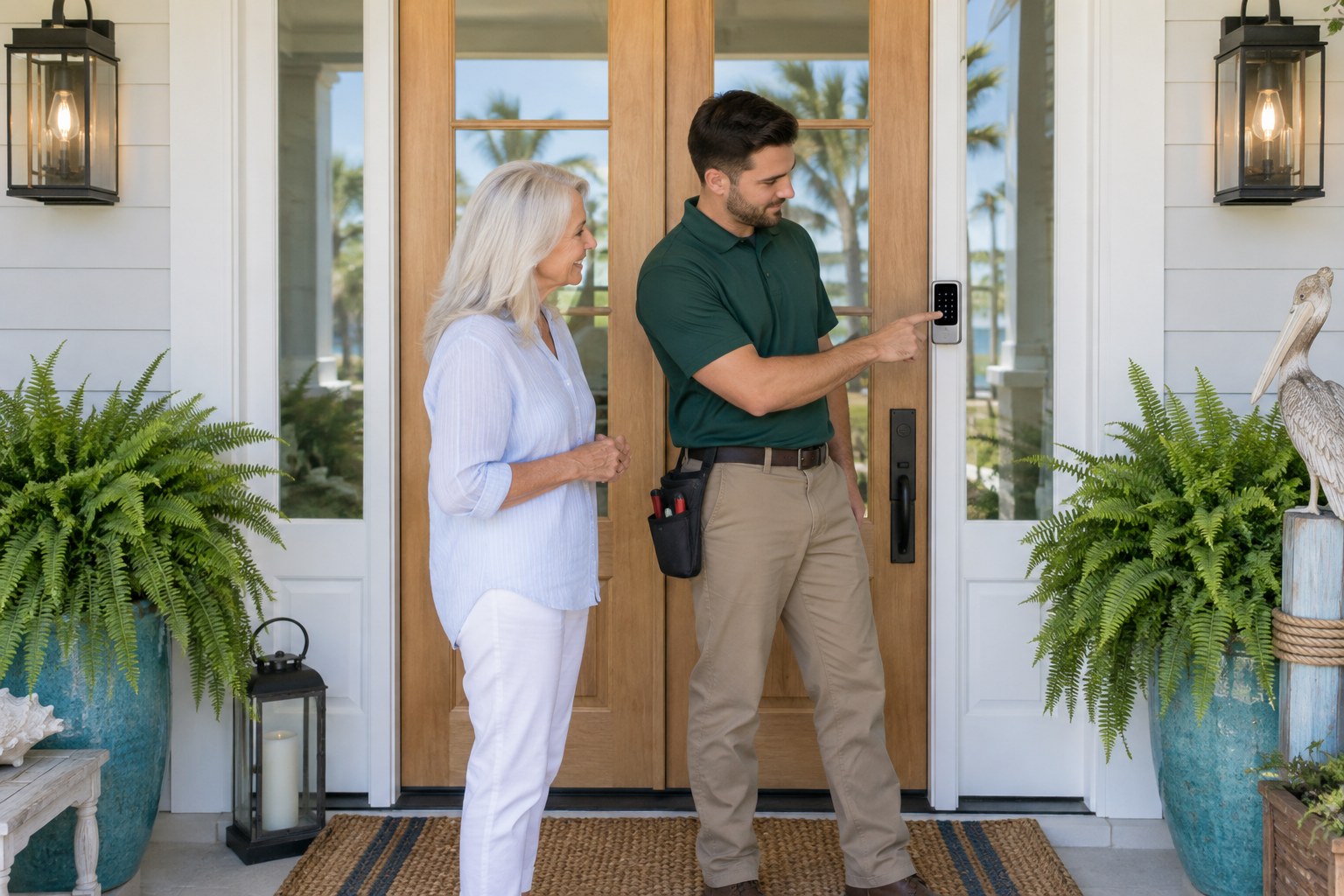
What jammed really means
People use the word jammed for several different failures. Sometimes the bolt is stuck in the strike hole and will not move at all. Sometimes the motor runs and stops halfway. Sometimes the lock beeps, whirs and gives an error. Each points to a different part of the lock, so it helps to describe the failure precisely.
An electronic deadbolt has a motor that drives a gear train, which pushes a bolt through a hole in the door edge and into the frame. Power comes from batteries. The lock senses where the bolt is, often with a small switch or sensor, and stops the motor when it thinks the job is done.
A jam can happen anywhere in that chain. Friction between the bolt and the strike can overpower the motor. A gear can strip or slip. A sensor can misread the position and keep the motor running or stop it too soon. Weak batteries can fail to finish the job.
Watching and listening carefully gives clues. A strong, fast whir that ends in a clunk is different from a weak groan that fades.
Mechanical binding first
Most jams start with the door, not the electronics. If the door has shifted, the bolt no longer lines up with the hole in the strike plate. The tip of the bolt rubs the edge of the plate, and the motor has to push against heavy friction. Eventually it gives up halfway.
Test this by opening the door and running the lock. If the bolt extends and retracts smoothly in open air, the lock is working, and the trouble is alignment. Then close the door and try again, watching where the bolt meets the plate. Marks or shiny spots on the strike show the contact point.
Weather matters. In the humid season, wood doors and frames swell, and the gap around the door closes. Heat can expand metal and make the fit tighter. The same lock that worked all winter may bind in August.
Adjusting the strike plate, easing the hole with a file or shimming the hinges often cures the jam without touching the lock.
- Run the lock with the door open to see smooth movement
- Look for scuff marks on the strike plate
- Check for door sag at the latch side
- Notice whether the problem is worse in wet weather
Power problems that mimic a jam
A motor needs a solid push of current to move a bolt against friction. When batteries get weak, the motor may start and then stall, which looks like a jam. The voltage sags under load, and the lock gives up even though the batteries seemed fine when tested.
Replace all cells with fresh alkaline batteries and test again. Clean the contacts if you see corrosion. Many jammed locks come back to life after a simple battery change, particularly in hot weather when cells weaken faster.
If you use rechargeable batteries, switch to alkaline for testing. Their voltage is lower and many locks do not work reliably with them.
If fresh batteries do not help, note whether the lock behaves differently with the door open. That tells you whether power or friction is the issue.
Worn gears and failing motors
The gear train inside an electronic lock is often plastic or soft metal. After thousands of cycles, teeth wear, and a gear can slip or strip. You may hear a clicking or ratcheting sound as the motor spins without moving the bolt. This is a hardware failure and cannot be fixed by cleaning.
Motors also wear out. A tired motor draws more current, runs hot and weakens. It may work when cool and fail when warm. It may have trouble in the evening after a long day in the sun and recover overnight.
Locks that cycle often, such as on a busy rental, wear faster. So do locks with auto lock features that fire several times a day. Counting cycles is hard, but age and use give a rough idea.
Once gears or the motor fail, replacement of the lock body is usually more sensible than repair, since parts are rarely sold separately.
Sensors, switches and confused electronics
Many locks use a small switch or magnet to know whether the door is closed and the bolt is in place. If that sensor gets dirty, misaligned or damaged, the lock may refuse to move because it thinks the door is open, or it may keep trying to move after the bolt has stopped.
Cleaning the sensor area and checking the magnet can help. If the lock has a door sensor, make sure the door is fully closed and the magnet is aligned with it.
Electronic errors can also come from moisture. Condensation inside the housing can cause intermittent faults that appear and disappear with the weather. A lock that works in the dry morning and jams in the humid afternoon may have this problem.
A reset can sometimes recalibrate the lock. Follow the manual carefully, and record your codes first.
If the bolt is stuck and the door will not open
The worst case is a bolt that is stuck extended with you on the wrong side. First use the key backup, which turns the bolt by hand through the mechanical cylinder. If the key turns freely, the bolt will retract.
If the key does not turn or the bolt resists, do not force it. A snapped key or a bent bolt makes everything harder. Stop, and consider whether the door is under pressure. Pushing the door toward the frame while turning the key sometimes releases a bolt that is jammed against the strike.
If you cannot get in, call us. The technician confirms that you own or have authority over the home, then selects a method. This may mean picking the cylinder, bypassing the latch or removing the exterior assembly.
After the door is open, they inspect the bolt, the strike and the lock.
How a locksmith diagnoses the jam
The technician starts by watching the lock work. With the door open, they cycle the bolt several times, listening for unusual sounds and checking how far the bolt travels. They check the batteries and measure how well the lock handles load.
Next, they close the door and test again. They look at the strike plate, the bolt hole and the gap at the edge of the door. They may use a marker on the bolt tip to show where it touches.
If the lock passes with the door open but fails closed, they correct alignment. If it fails in both cases, they move to the lock itself: removing the interior assembly, checking wiring, and examining gears and the motor.
The technician then explains what they found in plain language, and offers repair or replacement.
Repair or replace
If the cause is alignment, repair is simple. The strike plate is moved or the hole is enlarged, hinges are tightened, and the lock is tested. The old lock then continues to work, often with better battery life because the motor no longer labors.
If the problem is battery contacts or a loose connection, cleaning or reseating may fix it. These are small repairs and quick to do.
If gears, the motor or the board have failed, replace the lock. A new lock comes with fresh parts, and the technician can match the backup key to your other locks. Choose a model that suits your door and your habits.
For common repairs an estimate can usually be shared by phone, though the technician will want details about the model and what the lock is doing. Whether someone can come out soon is something to settle during that same conversation, since schedules change from day to day.
Heat, humidity and salt air
The Gulf Coast climate is hard on electronic locks. Humidity condenses inside housings, salt air corrodes contacts, and summer sun heats doors beyond what many electronics prefer. A lock rated for outdoor use and sealed against moisture lasts far longer than a basic indoor model.
Shade helps. A porch cover or an awning keeps rain and direct sun off the lock. If your door is exposed, consider a model with a weather gasket and a corrosion resistant finish.
Wipe the lock occasionally with a soft damp cloth to remove salt. Avoid spraying cleaners directly onto it. Replace batteries on a schedule, since heat shortens their life.
After storms, check that the lock still moves smoothly and that no water has entered.
Reasons to phone in a jammed electronic lock
Call if the bolt is stuck and you cannot get in, if the lock jams repeatedly after fresh batteries, if you hear grinding or clicking from the motor, or if you want help choosing a replacement. Describe what the lock does and what you have tried.
Photos of the lock, the door edge and the strike help. A quote is given by phone for common work. If the job is complicated, a technician visits first, and the service call charge is explained before dispatch.
We confirm that you own or have authority over the property before opening or changing a lock.
If you prefer a simple mechanical deadbolt over electronics, we can discuss that too.
Reading the sounds a jammed lock makes
Your ears are a useful diagnostic tool. A healthy electronic deadbolt makes a short, even whir and ends with a solid clunk as the bolt seats. When something is wrong, the sound changes in ways that point toward the cause, and describing them to a technician over the phone can save a good deal of time.
A slow, labored groan that fades before the bolt finishes usually means weak batteries or heavy friction. A fast whir with no movement suggests stripped gears or a motor spinning without gripping the bolt. A rhythmic clicking or ratcheting points to a slipping gear, and a harsh grinding noise suggests metal rubbing on metal, perhaps a bent bolt or debris in the mechanism.
Silence is informative too. If the keypad lights up but nothing moves and nothing sounds, the board may not be sending power to the motor, or the motor may have failed outright. If the lock gives a long error beep each time, the sensors may be reporting a fault such as a door that is not fully closed.
Try recording a short video of the lock working with the door open and closed. Sound and motion together tell a technician far more than a written description, and you will be able to compare before and after the repair.
Frames, hinges and doors that move with the seasons
Many jams that look electronic are really carpentry. Houses breathe through the year. Wood swells in a wet summer, shrinks in a dry spell, and settles a little more after every storm. A door that fit well when the lock was installed may lean slightly years later, and an electronic bolt, which has limited force, notices before a hand turned key does.
Look at the gap between the door and the frame along the latch side. It should be even, about the thickness of a coin. If the gap is wider at the top or the bottom, or if the door rubs on one side, the hinges may be loose or the frame may have shifted. Tightening the hinge screws, especially the top ones, often lifts the door back into place.
Check the bolt hole in the door edge and the hole in the strike. Paint, dirt or swollen wood can narrow them. Cleaning the holes and enlarging them slightly gives the bolt more room. A technician uses careful tools to do this without weakening the frame, and may add a longer strike plate screw to improve strength.
Fixing the door side not only cures the jam but also protects the lock. A motor that no longer fights friction lasts longer, batteries last longer, and the lock is less likely to fail at an awkward moment.
Stopgap steps while you wait for service
If the lock is jammed but the door is closed and locked, you may simply wait for the technician. Keep the key backup handy, and avoid cycling the lock repeatedly. Every extra try stresses a motor that may already be failing, and can wear the last of the gears.
If the bolt is retracted and the lock will not extend it, the door is not secure. Use a temporary measure such as a security bar, a door wedge from inside or a secondary lock. If you must leave, lock the door with a key if the backup cylinder works, or ask someone you trust to stay until repairs are made.
Do not remove the lock to see inside unless you know how to put it back. Disassembly can lose small parts and disconnect wiring, and it may void any coverage from the manufacturer. Take photos of the lock and the symptoms instead.
Call us to describe the situation and confirm availability. A quote is given by phone, and the earlier you call, the shorter the time your door stays in a weak state.
A careful sequence of checks you can try before anyone arrives
If an electronic lock is jammed but the door is not urgent, a few gentle checks may tell you a lot. Start by opening the door and closing it again slowly, watching how the bolt lines up with the hole in the frame. If the bolt scrapes or hits the edge of the strike, the jam may be from alignment rather than the lock. Lift the door slightly by its handle while you operate the lock. If it works with a lift, the problem is the door sagging on its hinges, and tightening hinge screws could be the first step.
Next, look at the power. Replace batteries with a fresh, matching set, and make sure they sit flat with clean contacts. If the lock has a backup key, try turning it in the cylinder with steady, light pressure. Never force the key, since a brass key snapped in a cylinder turns a small repair into a larger one. If the key turns smoothly but the door still will not open, the bolt may be the part that is stuck, and it is better to stop than to keep pulling at the handle.
Do not spray lubricant into the electronics, and do not pry at the housing with a screwdriver. Moisture and force are the two common ways to turn a repairable lock into a replacement. If you have already tried the steps above, note what happened and what you heard, and keep the batteries and any manual nearby. That summary lets the technician arrive with the right parts in mind and cuts down on guesswork when the door is finally open.
Rentals, shared entries and managed properties
In rentals and managed buildings, an electronic lock often belongs to the owner. If it jams, tell the landlord or manager promptly and in writing, and ask who handles repairs. Do not try to change or remove the lock without permission, since the lease may require approval and an unapproved change could cause a dispute.
A locksmith can open a jammed door once you show that you live there, and can diagnose the lock. Repair or replacement normally needs the owner's agreement, and the technician will explain what they found so you can pass it on. Keep any notes and photos for your records.
Property managers with many doors benefit from tracking models, install dates and battery changes. A jam often follows a pattern, such as every lock of the same age failing in the same season. Recording that history helps plan replacements before doors fail at inconvenient times.
For short term rentals, a jammed lock strands guests, so keep a backup key in a lockbox and a technician's number ready. Test every lock between stays, with the door open and closed, to catch binding early.
Questions people ask us
Why does my electronic deadbolt stop halfway?
Common causes are friction from a misaligned strike, weak batteries or a worn motor or gear. Test the lock with the door open. If it runs smoothly, alignment is the issue.
Can I force a jammed bolt?
No. Forcing can bend the bolt or break the gears. Use the key backup gently, and call a technician if it does not turn.
Will new batteries fix a jam?
Sometimes. Weak cells can stall the motor under load. If a fresh set does not help, check alignment and the lock itself.
Is it worth repairing a jammed electronic lock?
If the cause is alignment or contacts, yes. If gears, motor or board have failed, replacement is usually better. The technician will explain.
Can you open the door without damaging the lock?
Usually. Most jams are opened through the key cylinder or a bypass. If damage is likely, the options are explained first.