
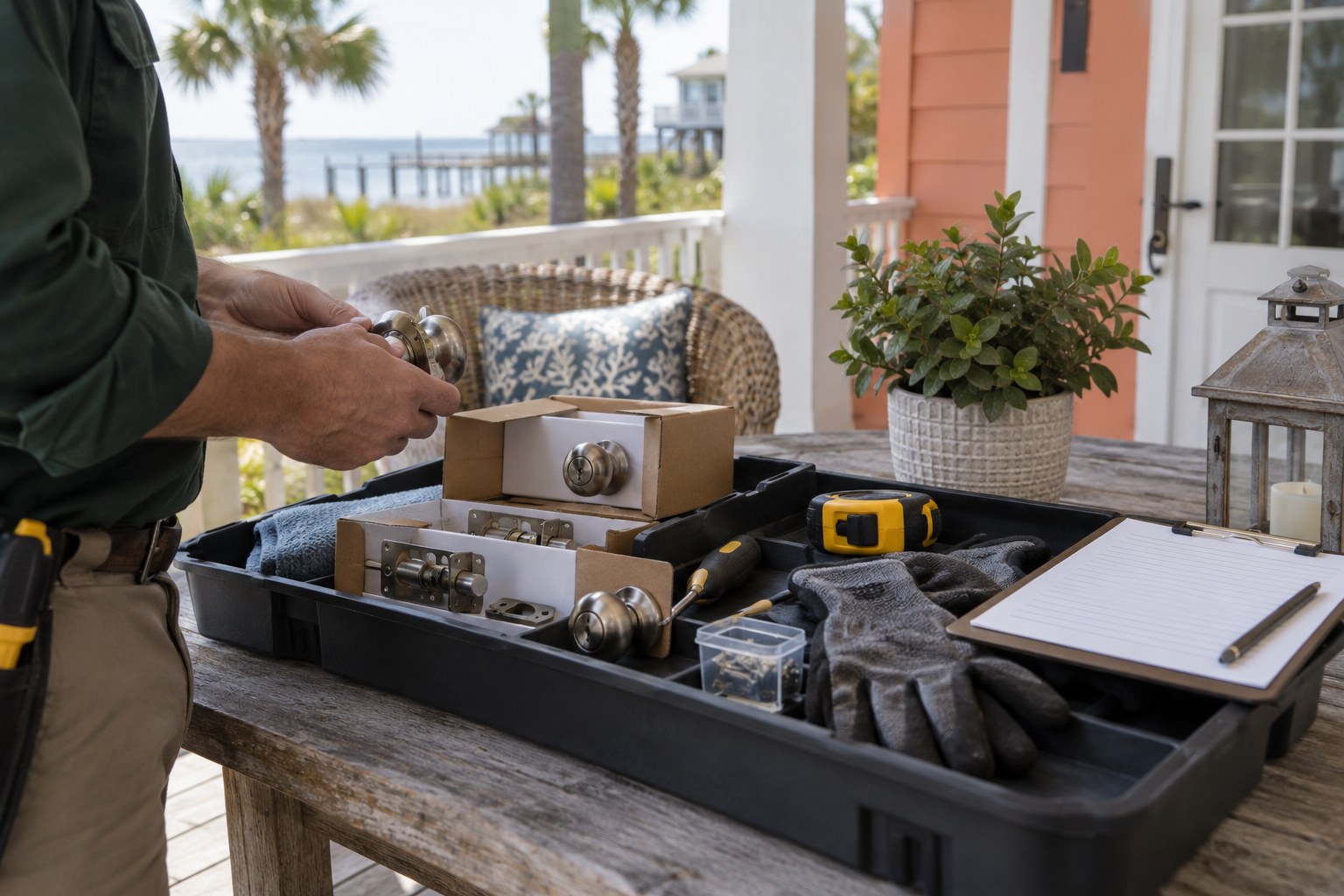
What makes a mortise lock different
A mortise lock is not a knob with a latch bolted on. It is a rectangular case, usually steel or brass, that slides into a pocket cut into the edge of the door. Inside that case sit the latch, the deadbolt, the springs, the levers and the connections to the handles, all working together in one assembly. The knobs, the key cylinder and the escutcheon plates are attached to this case.
Because the case is deep, the door has to be thick enough to hold it, which is why you usually see mortise locks on solid wood doors from an earlier era. The pocket weakens the door edge a little, so these doors rely on the hardware plate to carry the load. A well fitted mortise lock feels heavy, solid and smooth when it is working.
Most mortise locks include both a spring latch, operated by the knob, and a deadbolt, operated by a key or thumb turn. Some have a single combination bolt that does both jobs. Others add features like a night latch, a privacy button or a deadlocking function. The variety is large, which is one reason that parts and repairs depend heavily on identifying the exact model.
Because the mechanism is housed in the door rather than in the handles, you can replace the knobs without changing the lock body. That is useful when the handles are worn but the inside is still sound. It also means the real wear is often hidden from view, so a technician has to remove the case to judge it.
Mortise lock symptoms and their likely causes
A knob that spins without moving the latch usually points to a worn or broken spindle, or to a set screw that has come loose. This is the most common mortise lock complaint and often one of the easiest to fix. The spindle is the square rod that connects both knobs through the case, and it can wear at the corners over decades of use.
A key that turns but does not throw the bolt suggests a worn cam, a broken spring inside the case, or a cylinder that has come loose. A key that is hard to insert or turns stiffly can mean a dirty cylinder, a damaged key, or a case that is binding because the door has moved. Each symptom narrows down where the technician starts looking.
A door that rattles may have loose mounting screws, worn bushings or a case that is no longer snug in the pocket. A latch that does not return fully can be a tired spring or old grease that has dried into a paste. The door may also feel as though it is dragging when the latch is not lined up with the strike.
Sometimes the problem is not the lock at all, but the door. Seasonal swelling, a sagging hinge or a shifted frame can make a healthy mortise lock seem faulty. Technicians check the door before blaming the hardware, so that you do not pay for a repair that does not solve the real cause. Humid coastal weather makes this a frequent trap.
Dirt and old paint are quiet enemies of mortise locks. Several coats on the faceplate hide the screws and fill the gaps around the latch, so the parts rub where they should glide. A careful technician scrapes and cleans the plate before removing anything, because forcing a painted screw can strip the head and turn a quick job into a long one that damages the finish of the door.
Parts inside the case and how they wear
The latch bolt in a mortise lock is spring loaded, with a stem that connects to a hub. When the knob turns, it rotates the hub, which draws the latch back. The springs in this mechanism are small and steel, and they weaken or snap with age, especially in a salty, humid environment. A broken spring is one of the most frequent repair items.
The deadbolt is moved by a lever or a cam, operated by the key cylinder. Levers have slots that guide movement, and over time the slots wear and the bolt can bind or fail to extend fully. Brass parts can tarnish and stick, while steel parts can rust. Cleaning and relubricating may revive a lock that has been neglected.
The cylinder is the part that accepts the key. In many mortise locks it is a standard size that screws into the case from the outside. This is useful because the cylinder can be rekeyed or replaced separately without touching the rest of the lock. If the cylinder is worn out, a new one can be installed and keyed to match your existing keys.
Springs, screws and small plates are also worth a look. Older cases sometimes have cracked or bent covers, and the screws that hold the cover shut may be missing. A technician opening the case will check every spring, every lever and every rivet. A thorough inspection takes time but prevents the lock from failing again right after repair.
Taking a mortise case apart is delicate, and that is why it is best left to someone who has done it many times. Springs under tension can leap out, and tiny parts can fall into the door pocket. A technician works over a cloth, keeps parts in the order they came out, and photographs the layout before disassembly, so everything returns to its place exactly.
Repair, rebuild or replace
Repairing a mortise lock begins by removing it from the door. The technician unscrews the face plate, takes out the knobs and the cylinder, and slides the case from its pocket. On the bench, the cover comes off and each part is inspected. Cleaning with a solvent, replacing springs, and lubricating the moving parts can bring a tired lock back to life.
Rebuilding goes a step further. It involves replacing worn parts such as levers, hubs and cams, and sometimes machining small fits. Some parts for older models are still available, while others are not, in which case a technician may fabricate a part or adapt a modern equivalent. The goal is a lock that works as it did when new.
Replacement is the better choice when the case is cracked, when key parts are unavailable, or when the lock is so worn that repairs would not last. Modern mortise locks are still made and many fit the old pocket, so you can keep the look of the door while gaining reliability. Your technician will explain which option makes sense for your situation.
Another option is to convert to a more modern lock by filling the mortise pocket and drilling new holes. This changes the door permanently and is usually a last resort, particularly on a historic or original door. Many owners prefer to preserve the mortise and upgrade the internals, which keeps the character of the home.
- Clean and lubricate: for dirty, sticky locks
- Replace springs and cams: for weak or broken parts
- Rebuild the case: for worn levers and hubs
- Replace with a modern mortise lock: when parts are not available
Keys, cylinders and rekeying
Rekeying a mortise lock is often straightforward because the cylinder can be removed on its own. The technician takes out the cylinder, changes the pins to fit a new key, and puts it back. Your old keys stop working, and the new ones operate the lock. This is useful after a move, after losing keys, or when a tenant leaves.
If the cylinder is a common type, it can be swapped with a modern high security cylinder. This improves resistance to picking and bumping while leaving the lock body in place. It is a cost effective upgrade for a door that is mechanically sound but has an old, worn cylinder. The technician can match the length so the cylinder sits flush.
Older homes sometimes have mortise locks with keys that have an unusual shape or are very worn. Copying a worn key can pass along its wear, so a new key cut from the original code, or a new cylinder, may be a better choice. Ask the technician whether a fresh set of keys would give you more reliable operation.
Before any rekeying, the locksmith checks ownership or authority. That applies to homes, apartments and rentals. The technician may ask for proof that you live there or are the manager. This is routine, and it protects residents from anyone who might want to change a lock on a home that is not theirs.
Keys for mortise cylinders are sometimes cut on a different blank than modern house keys, so copies from a general hardware counter may not match perfectly. A locksmith can cut keys by code or from a good original, and test them in the lock before you leave. Spares are worth making while the lock is working well, not after the last good key is lost.
Gulf Coast conditions and older homes
Pensacola has a long history of older homes, from wood framed cottages to larger houses built when mortise locks were standard. Many still have the original hardware. Humidity, salt air and years of paint layers have taken their toll. A mortise lock that has been painted over several times may have stiff levers and clogged screw heads.
Salt in the air attacks steel springs and leaves deposits inside the case. Lubricants made for locks help, but heavy oils collect dust and sand. A technician typically uses a light lubricant and cleans the case to remove old residue. If the lock sits near a beach or bay breeze, more frequent checks are wise.
Storm season adds another factor. Wind pressure can push a door against its stop, straining the latch and the strike. Swollen wood can bind the case in its pocket. Checking that the door and the lock are in good shape before the season starts reduces the chance of trouble during a storm, when help can be harder to arrange.
For rental properties and short term stays, an older mortise lock can be confusing for guests who are used to modern locks. Clear instructions, or an upgrade to a more intuitive handle, can prevent frustrated calls. A technician can also advise on keeping the original appearance while improving how easy the lock is to use.
Remember that the door itself deserves attention. A mortise pocket cut years ago may have cracked at the corners or loosened from repeated use. A technician checks that the wood around the case is sound and can reinforce it with a small repair. Strong wood around the lock keeps the hardware seated and the whole assembly working as designed.
Security considerations for old hardware
Old mortise locks can be strong, but their security depends on the condition of the case, the cylinder and the strike. A thin, worn strike plate or a loose frame can undermine even a sturdy lock. A technician looks at the whole assembly, not just the lock, when thinking about how secure a door really is.
Some old cylinders are easy to pick or bump because the tolerances have worn. Replacing the cylinder with a modern one with tighter tolerances and security pins makes a real difference. The rest of the mortise lock can remain in place. This is often the most efficient security upgrade for an older door.
Glass panels in or next to the door are another weak point. If a person can break the glass and reach the thumb turn, the lock offers little protection. Options include a double cylinder lock, security film on the glass, or replacing the panel. A technician can discuss tradeoffs, including how quickly you can exit in an emergency.
Finally, consider the frame. Older frames have dried and cracked, and strike plates are often attached with short screws. Replacing them with longer screws and a reinforced strike spreads the force to the framing. This is a modest job that improves the security of the door a good deal.
Escutcheon plates, the decorative covers around the keyhole and handle, can hide damage. When they are removed during repair, you may see enlarged holes or cracked wood around the spindle. These details affect how the new parts will sit, so the technician addresses them at the same visit rather than leaving a hidden fault for next time.
Faceplates, trim and the finishing details on old mortise sets
With an older mortise lock, the part you see is only a small fraction of the whole. The visible escutcheon plates, knobs, thumb latches and faceplate often carry a decorative finish that matters as much to the owner as the lock itself. A careless repair can scratch, strip or mismatch that finish and leave a door that works well but looks wrong. We work slowly around trim, protect surfaces with tape and cloth, and keep every screw in order, because old screws are often a specific size or thread that cannot be replaced from a modern bin.
Many mortise sets were fitted by hand into a pocket cut in the edge of the door, and no two pockets are quite alike. That means a replacement case has to be chosen with care. The backset, the height of the spindle, the thickness of the door and the spacing of the faceplate holes all affect whether a new part will drop in or need modification. Sometimes the best answer is to restore the original case with new springs and a clean, and sometimes a modern case made for the same pocket is the sensible compromise.
Before the visit, find any old keys, spare knobs, loose plates or stray hardware from the door, even if they seem useless. Photograph the edge of the door with the door open, and take one close picture of the faceplate. Mention if the knobs have ever been replaced, because mismatched spindles are a common cause of rattling and sticking. If the lock is important to the character of the home, tell us so, and we will treat preservation as a goal instead of an afterthought.
Planning a visit and what to have ready
When you call, describe the symptoms, the age of the door, and what the lock looks like. Mention if there is a keyed cylinder, a thumb turn, or a separate deadbolt. Photos of the faceplate and the knobs help the technician identify the lock before arriving, and may allow the right parts to be brought along.
Quotes are given by phone. If a job is complicated, such as rebuilding a mortise lock or fabricating a part, a technician visits and the service call charge is explained before dispatch. We do not promise arrival times, so call to confirm availability in Pensacola, Escambia or Santa Rosa county.
Have your keys ready, including any spares, and know who has copies. Clear access to the door and a place to work makes the repair smoother. If the door is part of a historic building or has particular rules, let the technician know so the work respects them. Ownership or authority is checked before work begins.
After the repair, test the lock with all keys, from both sides, and with the door in different positions. Ask for a few maintenance tips tailored to your climate. A mortise lock that is well maintained can serve for many more years, which is part of what makes preserving it worthwhile.
Questions people ask us
How do I know if I have a mortise lock?
Look at the edge of the open door. A mortise lock has a deep rectangular faceplate set into the edge, often with a latch and a deadbolt in the same plate. The door is usually thick and solid wood. Many are found in older homes, and they often have a separate escutcheon plate with the keyhole.
Can a mortise lock be repaired or does it need replacing?
Many can be repaired. Springs, cams and levers can often be replaced, and the case cleaned and relubricated. Replacement is better when the case is cracked or parts are unavailable. The technician examines the lock and explains the options before starting work.
Can I change the key without replacing the whole lock?
Usually yes. The cylinder can often be removed and rekeyed, or swapped for a new one, while the case stays in the door. Your old keys stop working afterward. The locksmith checks ownership or authority before rekeying a home lock.
Why does my old lock stick in humid weather?
Humidity swells wooden doors and frames, and it encourages rust and tarnish inside the lock. Salt air makes this worse near the coast. A technician can tell whether the problem is the door or the lock, then clean, adjust or repair as needed.
How do quotes work for mortise lock repairs?
Quotes are given by phone after you describe the lock and the problem. For more complicated work, a technician visits and the service call charge is explained before dispatch. Call us to confirm availability in your part of the Pensacola area.