
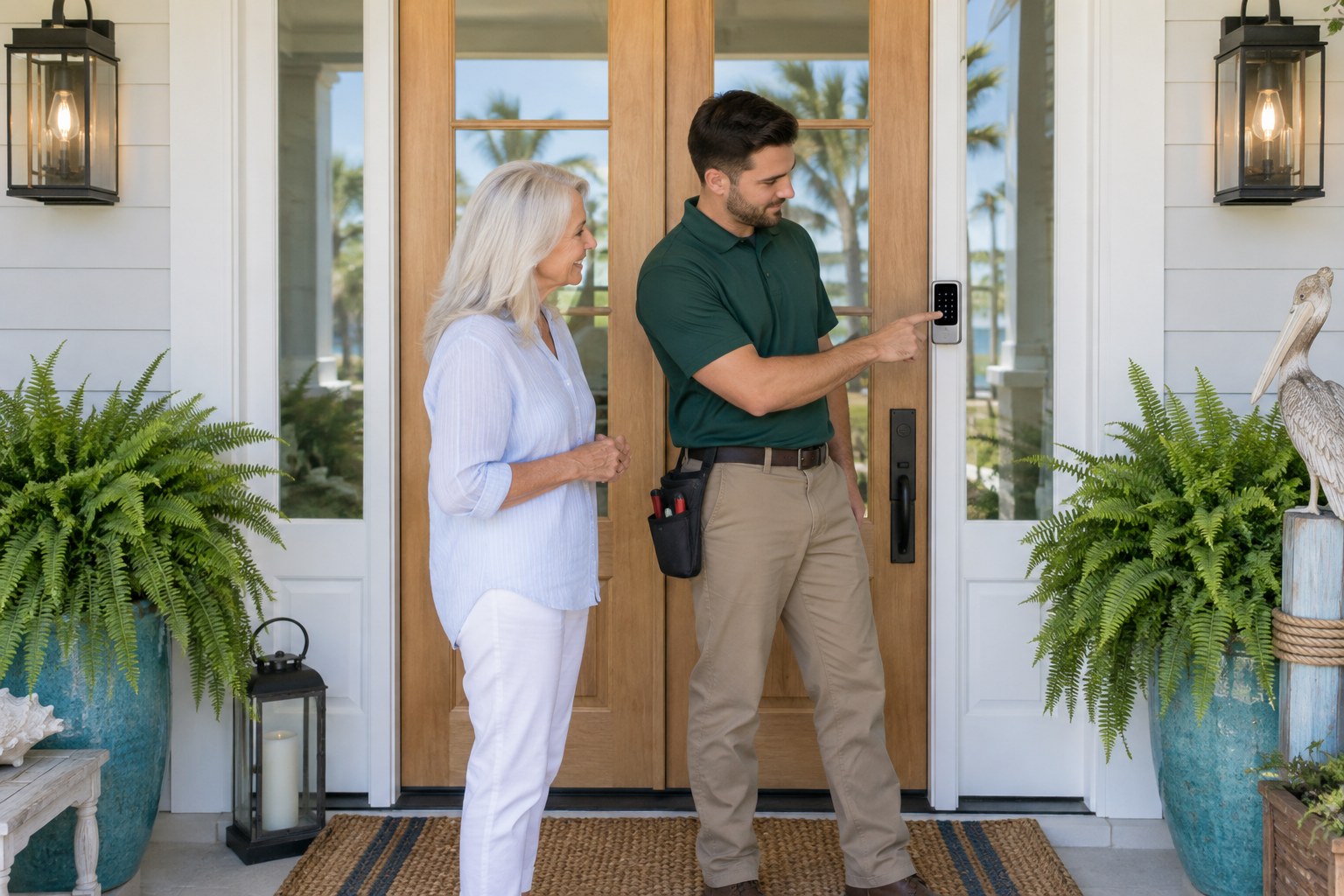
What a keypad lock is made of
A keypad deadbolt looks simple from outside, but it holds a small electronic system. Behind the buttons is a circuit board that reads your code. When it matches, the board sends power to a small motor, which turns a gear train that slides the bolt in or out. A battery pack, usually four AA cells, supplies the power.
Most models keep a mechanical backup. Under a cover or hidden in the faceplate sits a normal keyhole connected to the same bolt. If the electronics fail, the key still works, as long as you have it. Some cheaper models lack this backup, which makes failures more serious.
Every part can wear. Buttons can crack or stick, the board can suffer moisture damage, the motor can weaken, and the gears can strip. In the Gulf Coast climate, humidity and salt air add corrosion to the list, particularly on doors that face the weather.
Understanding that chain helps you diagnose where the break happened: power, input, motor or bolt.
Start with the batteries
The most common reason a keypad stops responding is low batteries. Many locks warn you with a beep, a flashing light or a slow motor, but those signs are easy to miss. When the batteries finally sag too low, the lock may go dark with no warning at all.
If the lock still responds a little, change all the batteries at once with fresh alkaline cells, in the correct direction. Avoid mixing old and new, and avoid rechargeable cells unless the manufacturer allows them, since their lower voltage can cause trouble.
Check the battery contacts. Look for white powder, green crust or rust. Wipe them gently with a cotton swab and a drop of rubbing alcohol. Corroded contacts can stop power even with new batteries.
If the lock is completely dead and the batteries are inside the door, you may need an emergency power source. Some models have terminals on the outside where a nine volt battery can be touched to wake the keypad.
- Replace all cells together with fresh alkaline batteries
- Check direction and spring contact tension
- Clean white or green corrosion from contacts
- Look for outside terminals for a nine volt boost
When the buttons do not react
If the lock has power but ignores your code, the keypad itself may be the issue. Look at the buttons. Do they feel sticky, mushy or stuck in? Dirt, sunscreen, cleaning sprays and salt can gather under the keys and make them misbehave.
Wipe the pad with a slightly damp soft cloth. Do not spray cleaner directly on the lock, since liquid can seep into the electronics. Dry it right away. If the buttons are cracked or the legends worn, replacement of the keypad assembly may be necessary.
Try your code slowly, pressing each button firmly and waiting for the beep. Some locks have a timeout between presses. If the lock has a lockout mode after too many wrong tries, wait the stated period before trying again.
If the keypad responds only in parts, such as some digits working and others not, the board or membrane is failing and the lock should be replaced.
The motor and the bolt
Sometimes the keypad beeps and lights up, but the bolt does not move, or moves partway and stops. That points to the motor or the mechanical path. A worn motor draws more power, labors and struggles, and the problem often shows up first in cold weather or with low batteries.
Alignment matters. If the door has shifted, the bolt may bind against the strike plate. The motor then cannot push through the friction. Try the lock with the door open. If the bolt extends and retracts freely, the problem is alignment, not electronics.
Listen for sounds. A whirring without movement suggests stripped gears. A grinding noise points to a bent bolt or jammed mechanism. No sound at all can mean no power to the motor.
If the bolt is stuck in the extended position, do not force the door. Use the key backup, and call for help.
Moisture, salt air and heat
Electronic locks and the coast are not natural friends. Warm, wet air condenses inside the lock when temperatures change, and salt particles ride in on the breeze. Over months, this attacks circuit boards and connectors, and a lock that worked well in the dry season can act oddly in humid weather.
Doors in full sun add heat stress. Plastic housings can warp, and batteries drain faster in high temperatures. Doors with a covered porch fare better than those with direct exposure to rain and sun.
Choose locks rated for outdoor conditions when replacing. Look for sealed keypads, weather gaskets and corrosion resistant finishes. A cover over the door also helps.
If your lock acts up after a storm or heavy rain, let it dry out, replace the batteries and test again. If problems persist, moisture damage may have occurred.
Using the key backup
If the keypad will not respond, the key is your way in. Look for a hidden keyhole under a sliding cover or behind a small panel on the faceplate. Some models disguise it as a decorative cap. Insert the key and turn as you would for any deadbolt.
Keep a spare key somewhere safe, not in the lock. Many people with keypads stop carrying keys and then cannot find one when needed. Store one with a trusted neighbor or in a lockbox, and test that it turns the lock.
If the backup keyway is stiff, spray a little dry lubricant. Avoid forcing the key, since a snapped key makes things worse.
If you have no key at all, a locksmith can open the door. Before work begins, the technician confirms that you own or have authority over the home.
How a locksmith opens a dead keypad lock
The technician looks at the model and chooses a method. Some keypad locks can be powered from outside with a nine volt battery, which wakes the board long enough to enter the code. Others can be picked through the backup cylinder, as with any deadbolt.
If neither works, the technician may bypass the lock at the latch, or remove the exterior assembly to reach the bolt mechanism. Most of these steps leave the door and frame undamaged. Drilling is rare and only used when the lock is locked up and damaged.
Once the door is open, the technician tests the lock on the bench or in place. They check the batteries, contacts, motor and bolt travel to find the fault.
Then you decide: repair the lock, replace it, or swap to a simpler mechanical deadbolt.
Repair or replace the keypad lock
If the issue is low batteries, corrosion on contacts or a misaligned strike, a repair may restore function. These are quick fixes, and the lock can return to normal use. The technician will also test the lock several times to confirm.
If the motor, board or gears have failed, replacement is usually the better path. Parts for consumer locks are not always sold separately, and a new lock comes with fresh hardware and settings.
When choosing a new lock, consider reliability. A keypad lock with a good reputation for build quality, a clear low battery warning and a solid key backup is worth more than one with many extra features. You can also match the key to your other locks.
A phone call is the easiest way to get a sense of cost for typical keypad repairs, and it is also the time to ask when a technician might be able to visit. Have the brand, model and a short description of the symptoms handy so the estimate fits your lock.
Batteries, schedules and habits
Set a reminder to replace batteries on a schedule, such as when daylight saving changes. Do not wait for the warning. Write the date on the inside of the door or on a label.
Keep spare batteries in a drawer near the door. A lock that dies at night is much harder to deal with when you have to search for cells.
Test your backup key twice a year. Turn it in the lock to confirm it works. Many people discover a problem with the backup only when they need it.
If you share the code with others, review the list from time to time and delete codes that are no longer needed.
Rental homes and shared codes
Keypad locks are popular in rentals because codes can be changed between guests. When the lock fails, a guest may be stuck outside. Keep a backup key in a lockbox, and make sure the cleaner and manager know where it is.
If you manage several doors, record the lock models and battery types. A simple list saves time on service calls and during turnover.
Tenants should report lock problems to the landlord promptly. The lock belongs to the property, and most leases require the owner to handle repairs. A locksmith needs to confirm authority before opening or changing a lock.
After a guest leaves, change the code. It is easier than rekeying and keeps access under control.
Deciding it is time to call about a dead keypad
Call if the keypad is dead and you have no key, if the bolt is stuck, if the lock keeps failing after battery changes, or if you see signs of damage or tampering. Describe the brand, the model if you know it, and what the lock does when you press a button.
Photos of the keypad, the back plate and the keyhole help. A quote is given by phone for common work. If the job is complicated, a technician visits first, and the service call charge is explained before dispatch.
Please be ready to confirm ownership or authority over the property. This is done for every customer, to protect you and your neighbors.
Clear the area around the door, and make sure pets are secure so the technician can work safely.
Smart keypads, apps and connected features
Many newer keypad locks connect to a phone through Bluetooth or a home network. They can send alerts, keep a log of who came in, and let you create codes from anywhere. These extras add convenience, but they also add more places for something to go wrong, including software updates, network drops and phone settings that block the connection.
If a connected lock stops responding to the app but the keypad still works, the lock itself is likely fine. Check that your phone has Bluetooth turned on, that the router is online, and that the lock has strong enough batteries to run its radio. Radios drain batteries far faster than the keypad alone.
If neither the app nor the keypad responds, treat it as a power or hardware problem and follow the same steps as for any dead lock. Do not repeatedly reset the lock without reading the manual, because a factory reset can erase every stored code, and you may then have to set them up again from scratch.
A locksmith can open a door with a dead connected lock the same way as a basic keypad, and can advise whether a simpler lock would suit your household better. Not everyone wants a lock that depends on a phone, and a plain keypad with a good key backup is a perfectly sound choice.
What happens if the lock is stuck locked or stuck open
A keypad lock can fail in two directions. If it fails locked, you cannot get in, and the key backup or a locksmith is the answer. If it fails unlocked, the bolt stays retracted and the door is open to anyone who pushes it. That second case is a security problem, even though nothing seems wrong when you walk through.
If your lock will not extend the bolt, do not leave the home unsecured and hope for the best. Use a temporary measure such as a door wedge, a secondary lock or a security bar from the inside while you are home, and arrange a repair as soon as you can. If you must go out, tell a trusted person and consider asking a neighbor to watch the door.
For a bolt that extends but will not retract, try the key backup. If the key turns freely and the bolt moves by hand, the motor is the culprit. If the bolt is hard to move even with the key, the door may be binding, or the bolt may be bent. In that case a technician should look at the door and frame as well as the lock.
Whichever way the lock fails, record what you saw and heard before you call. A description such as the lights flash but the motor is silent, or the bolt moves slowly and stops, saves time and helps the technician bring the right parts.
Getting the keypad door ready for the technician
A keypad lock communicates in a limited vocabulary, and each signal narrows down the cause. A lock that lights up and beeps but does not move the bolt points toward the motor or the bolt itself. A lock that shows nothing at all suggests dead batteries or a broken connection. A lock that flashes red or beeps in a long run after each code usually means the code was rejected, or the lock has gone into a short lockout after too many wrong tries. The manual for your lock lists these patterns, and a quick look is worth the minute.
Pay attention to the order of events. Did the lock stop working after a storm, after a battery change, or after someone cleaned the door? A lock that fails right after new batteries went in may have a battery inserted backward, or a cover that was not seated, so the contacts never touch. A lock that fails after heavy rain may have taken on moisture in the keypad. Write down what you noticed and when, because that timeline is more useful to a technician than a general statement that the lock just stopped.
If the display behaves normally but the door will not accept your code, consider whether the code was changed. In households with several people, someone may have updated a code or deleted a user to tidy the list. Try any master or programming code you have recorded. Avoid pressing buttons repeatedly in a panic, since many models lock the keypad for a stretch after several errors, and that delay can look like a complete failure. Slow, deliberate entry, once, is the better approach.
Getting the entry ready for the technician
Before the technician arrives, gather what helps. Find the lock manual or the model number, which is often on a sticker inside the battery cover. Collect any spare keys, even ones you think do not work. Write down whether the lock was ever repaired or had its code reset recently.
Make sure the technician can reach the door. Move shoes, mats and potted plants away from the entry. If the lock is on a gate or a side door, clear the path and open the gate. If a pet could dart out when the door opens, keep it in another room.
Have proof that you live at the property or have authority over it. A driver license with the address, a lease, a utility bill or a message from the owner will do. This check is routine and applies to every job.
Finally, decide in advance how much you want done. Some people want only the door opened. Others want the lock repaired or replaced on the spot, with a spare key cut. Knowing your preference makes the call smoother and the visit shorter.
Questions people ask us
Why is my keypad lock dead after I changed the batteries?
Check that the batteries are in the correct direction and fully seated. Corroded contacts can block power even with fresh cells. Clean them gently. If the lock still does not respond, the board or motor may have failed.
Can I get in if the keypad is completely dead?
Often yes, through the backup keyhole or by touching a nine volt battery to outside terminals on some models. If neither is available, a locksmith can open the door after confirming ownership.
Is it normal for a keypad lock to fail in humid weather?
Moisture and salt air can cause problems, especially with locks not rated for outdoor use. A drying out period, fresh batteries and a sealed, weather rated lock can help.
Should I repair or replace a keypad deadbolt?
Simple causes like batteries or alignment are worth fixing. If the motor or board is bad, replacement is usually more sensible. The technician will tell you which applies.
Can a keypad lock be keyed to match my other locks?
Many can. The backup cylinder is often rekeyed to match your existing key, so one key works for several doors.